


Views: 0 Author: Site Editor Publish Time: 2026-10-28 Origin: Site


Did you know that inadequate thermal management is a leading cause of catastrophic equipment failure? Facility managers and system engineers constantly struggle to strike a delicate balance. They must maintain high-volume airflow, curb soaring energy costs, and ensure uninterrupted performance. Keeping industrial and commercial spaces safe requires a robust, heavy-duty solution. An AC axial fan offers a reliable, cost-effective, and time-tested cooling mechanism. These devices are specifically engineered to move massive volumes of air. In this comprehensive guide, we will explore the foundational mechanics of these devices. You will learn their core benefits, compare them against alternative technologies like DC and EC models, and discover how to select the perfect unit for your specific industrial applications.
High Airflow Efficiency: Aerodynamically designed to move large volumes of air at low static pressure. They are the ideal choice for general space ventilation, exhaust systems, and rapid equipment cooling.
Cost-Effective and Plug-and-Play: Connects directly to standard alternating current power grids. This completely eliminates the need for expensive power supply units, transformers, or complex electronic commutators.
Unmatched Durability: Built specifically for harsh industrial environments with robust metal housings. They require minimal maintenance over their lifespan and resist damage from dust, moisture, and temperature fluctuations.
Versatile Applications: The technology is highly adaptable. It is successfully deployed across heavy manufacturing plants, HVAC systems, server rooms, and agricultural greenhouses.
Smart Alternatives: While DC and EC fans provide variable speed control and lower power consumption, alternating current models remain the undisputed champions for reliable, continuous airflow at a significantly lower initial capital investment.
Recent market analyses reveal a significant shift in industrial cooling strategies. As global manufacturing hubs experience increasingly extreme summer temperatures, the demand for resilient thermal management systems has skyrocketed. Facility operators are moving away from overly complex, fragile cooling systems in favor of rugged reliability. While smart, variable-speed technologies have their place, traditional alternating current ventilation remains a dominant force. This sustained popularity is driven by its unparalleled ability to withstand grid fluctuations and dirty power environments without suffering catastrophic electronic failure. In short, modern industries are prioritizing maximum uptime and mechanical simplicity over marginal energy savings.
To make informed procurement and engineering decisions, it is essential to understand the foundational technology behind these cooling devices. Their widespread adoption across global industries is largely due to mechanical simplicity and reliable physical principles. When a technician wires the unit into a control panel, they are leveraging decades of refined electromechanical engineering.
An alternating current fan operates using electricity supplied directly from a standard electrical grid. The motor consists of two primary components, which are a stationary stator and a rotating rotor. When alternating current flows through the copper windings of the stator, it generates a rapidly fluctuating magnetic field. Furthermore, this alternating magnetic field induces an electric current in the rotor to create an opposing magnetic force.
The interaction between these two forces causes the rotor to spin. This rotational force drives the attached impeller blades. Because the design relies on the natural frequency of the power grid, typically 50Hz or 60Hz, the motor operates at a consistent and predictable speed without requiring complex internal electronics. This inherent simplicity drastically reduces the number of potential failure points within the hardware. Consequently, the system runs smoothly even under continuous, demanding loads.
The term axial flow refers to the specific trajectory of the air as it moves through the device. In this design, air is drawn in parallel to the central axis of the rotating blades and is pushed out in the exact same straight-line direction. You can think of it like an airplane propeller cutting through the sky. This straight-through airflow dynamic is highly efficient for moving large volumes of air over open spaces.
In contrast, other designs such as centrifugal blowers draw air in axially but expel it perpendicularly at a 90-degree angle. Centrifugal designs are highly useful for pushing air through restrictive ductwork. However, the axial design remains far superior for high-volume, straight-line ventilation where minimal airflow resistance is present.
When selecting thermal management components for industrial or commercial use, procurement teams must carefully weigh performance against cost and longevity. The right choice directly impacts facility profitability and safety.
At its core, the primary function of any ventilation system is to rapidly displace hot, stagnant air with a cooler breeze. Axial designs are aerodynamically optimized to maximize Cubic Feet per Minute. The pitch and surface area of the blades are engineered to scoop and propel massive amounts of air with every single rotation.
This high airflow capacity is absolutely crucial for cooling large open spaces, such as factory floors, or for rapidly dissipating heat from large machinery. By moving a high volume of air continuously, these devices prevent localized heat pockets from forming. This action protects sensitive mechanical and electrical components from severe thermal degradation.
Budget constraints are a harsh reality in every facility management scenario. One of the most significant advantages of this technology is its remarkably low initial purchase price. Because the motors run directly on grid power, they do not require internal converters, printed circuit boards, or electronic commutators.
The absence of these delicate electronic components significantly reduces manufacturing costs. Consequently, choosing a standard industrial AC axial fan is highly affordable to both purchase and replace. For large-scale infrastructure projects requiring dozens or hundreds of cooling units, this cost-effectiveness translates into substantial capital savings.
Industrial environments are notoriously unforgiving. Equipment is routinely exposed to airborne dust, chemical vapors, high humidity, and extreme ambient temperatures. Alternating current models are typically constructed with rugged materials, such as die-cast aluminum housings and heavy-duty steel or specialized thermoplastic impellers.
Furthermore, because they lack sensitive internal electronics, they are far less susceptible to failure from power surges or high heat. Many models feature impedance-protected motors or thermal overload protection. This prevents the motor from burning out if the blades become accidentally obstructed. This robust construction ensures a long operational lifespan with minimal required maintenance, which drastically reduces overall downtime for the facility.
The plug-and-play nature of these devices simplifies the installation process immensely. They are designed to be wired directly into standard mains power, typically available in 115V or 230V configurations. This direct connection eliminates the frustrating need to install secondary power supply units or bulky transformers inside the equipment enclosure. By reducing the number of required components, engineers save valuable space within control panels and significantly cut down the labor hours required for wiring and system integration.
A common challenge during the system design phase is choosing between axial and centrifugal airflow technologies. There is no universally superior option. The correct choice depends entirely on the specific environmental variables and the physical layout of the application at hand.
As previously established, axial models excel in scenarios requiring high airflow volume at low static pressure. They are meticulously designed to move air freely from one open space to another. This makes them the optimal choice for applications like exhaust ventilation in warehouses, cooling towers, and general room air circulation. If the goal is to quickly lower the ambient temperature of a large room or to pull hot air out of a spacious equipment cabinet without forcing the air through dense filters, the axial design is universally the most efficient and practical choice.
Centrifugal fans, commonly known as blowers, operate on a vastly different aerodynamic principle. By utilizing a scroll housing and a specialized impeller, they generate exceptionally high static pressure. This high pressure is strictly necessary when air must be pushed through highly restrictive pathways, such as long HVAC ductwork, dense HEPA filters, or complex automotive cooling systems. While they move less total air volume compared to axial models of a similar size, they maintain their airflow much better against systemic resistance.
Feature | AC Axial Fan | Centrifugal Fan Blower |
|---|---|---|
Airflow Volume | Very High | Low to Medium |
Static Pressure | Low | Very High |
Airflow Direction | Straight, parallel to axis | 90-Degree Angle, perpendicular |
Initial Cost | Generally Lower | Generally Higher |
Physical Footprint | Compact and shallow | Bulky, requires scroll housing |
Best Use Case | Open space cooling, general exhaust | Ducted systems, dense filtration |
The landscape of thermal management has evolved rapidly. Direct Current and Electronically Commutated fans are increasingly common in the commercial market. Understanding how traditional alternating current models compare to these newer technologies is vital for justifying procurement choices and optimizing facility budgets.
Direct current fans operate on low voltage, such as 12V, 24V, or 48V, and are highly valued for their precise speed control and low power consumption. However, they cannot connect directly to a standard wall outlet or industrial power grid. To use a direct current fan, you must purchase and carefully install a power supply unit to convert the alternating grid current into direct current. This adds cost, complexity, and an additional point of failure to the system.
In contrast, alternating current models win on raw, continuous power and sheer simplicity. By connecting directly to the grid, they completely avoid the hidden costs and space requirements associated with external power converters.
Electronically Commutated fans represent a modern hybrid technology. They connect to mains power but use an internal electronic board to convert the current to direct current, driving a highly efficient brushless motor. These fans are exceptionally energy-efficient and offer precise variable speed control. This makes them popular in smart-building applications.
However, this advanced technology comes with a significantly higher upfront cost. Additionally, the internal electronics can be highly sensitive to extreme temperatures, voltage spikes, and dirty power environments often found in heavy industry. Standard alternating current models boast a much lower initial cost and a simpler, more rugged maintenance profile. They remain the perfect, reliable choice for systems that require a constant, high-volume speed without the need for complex digital controls.
Because of their unwavering reliability and high airflow capacity, these devices are trusted across a wide spectrum of demanding industries. They serve as the invisible backbone for numerous critical thermal management systems worldwide.
In the commercial heating, ventilation, and air conditioning sector, moving air efficiently is the primary objective. These fans are heavily utilized in outdoor condenser units, where they pull ambient air across refrigerant coils to dissipate heat extracted from the building. They are also widely used in commercial exhaust systems, roof ventilators, and underground parking garage ventilation setups. Their unique ability to run continuously for thousands of hours makes them indispensable for maintaining indoor air quality.
Imagine a bustling factory floor where welding sparks, oil mist, and heavy vibrations are a constant reality. Heavy manufacturing relies on machinery that generates substantial amounts of heat. Industrial control panels, variable frequency drives, and large power transformers require constant cooling to prevent catastrophic thermal failure.
Industrial AC cooling fans are mounted directly onto electrical cabinets and machinery housings to violently exhaust hot air and draw in cool ambient air. Their sturdy metal construction allows them to survive in factories that would quickly destroy lesser consumer-grade equipment.
Agriculture, particularly controlled-environment agriculture like greenhouse farming, requires precise climate control. Plants need proper air circulation to strengthen stems, prevent fungal diseases, and regulate humidity levels. Axial fans are strategically deployed to create consistent airflow across large greenhouse spans.
Furthermore, livestock facilities use these fans to prevent severe heat stress in animals during sweltering summer months. The fans chosen for these environments must be highly resilient. They operate in constant high-humidity conditions and are often exposed to abrasive agricultural dust and corrosive ammonia from animal waste.
Beyond the initial purchase price and performance specifications, the total cost of ownership is heavily influenced by how easily a component can be installed and maintained over its lifecycle. Time is money in industrial settings. Complex installations inevitably lead to prolonged equipment downtime.
These fans are designed with standardized form factors and mounting holes, making them universally compatible with standard equipment racks, enclosures, and ventilation ducts. Most models utilize a simple flange mount system, allowing technicians to secure the unit with four standard screws in mere minutes.
Electrically, installation is equally straightforward. They typically feature either standard wire leads or terminal connectors. This allows an electrician to wire the unit directly to the mains power without programming controllers or installing secondary power supplies.
While these devices are exceptionally durable, implementing basic maintenance practices will significantly extend their operational lifespan. First, regular cleaning of the impeller blades is absolutely necessary. Dust accumulation on the blades alters their aerodynamic profile. This forces the motor to work harder and reduces airflow output.
Second, monitoring bearing health is critical. Fans equipped with dual ball bearings generally last upwards of 50,000 hours and tolerate higher temperatures, while sleeve bearings are quieter but have a shorter lifespan. Ensuring the fan is mounted securely to prevent excessive vibration and verifying that the intake and exhaust pathways remain unobstructed will guarantee optimal performance for years to come.
Selecting the appropriate thermal management equipment requires a systematic evaluation of environmental variables, mechanical constraints, and electrical infrastructure. Facility managers and engineers cannot rely on guesswork when specifying cooling components. Undersized fans lead to catastrophic equipment failure, while oversized units result in unnecessary energy expenditure and excessive acoustic noise.
The fundamental purpose of any ventilation system is to displace a specific volume of air within a given timeframe. In the United States, this metric is universally quantified as Cubic Feet per Minute. To determine the exact airflow required for a facility or an electrical enclosure, engineers utilize a standard calculation based on the volume of the space and the necessary Air Changes per Hour.
The baseline formula for determining minimum airflow is: Required Cubic Feet per Minute equals the Volume of the Space in Cubic Feet multiplied by the Desired Air Changes per Hour, all divided by 60.
For example, a manufacturing control room measuring 20 feet by 20 feet with a 10-foot ceiling has a total volume of 4,000 cubic feet. If industry standards dictate that this specific environment requires 15 air changes per hour to dissipate heat safely, the calculation would be 4,000 multiplied by 15, then divided by 60. This results in a strict requirement of 1,000 Cubic Feet per Minute.
However, airflow cannot be evaluated in a vacuum. It must be paired with an understanding of static pressure, which is the resistance to airflow within a system. Components such as dense dust filters, narrow ductwork, or tightly packed server racks create high impedance. Always select a fan with an airflow rating slightly higher than your baseline calculation to compensate for this system impedance.
Facility / Application Type | Recommended Air Changes per Hour | Primary Cooling Objective |
|---|---|---|
Electrical Control Cabinets | 30 - 60 | Rapid heat dissipation from active components. |
Server Rooms / Data Centers | 20 - 30 | Strict temperature regulation and moisture control. |
Industrial Workshops | 10 - 15 | General ventilation and airborne particulate dilution. |
Agricultural Greenhouses | 6 - 12 | Humidity regulation and plant transpiration support. |
Warehouse Storage | 4 - 8 | Stagnant air elimination and basic temperature leveling. |
The operational environment heavily dictates the physical construction of the fan. Premature mechanical failure is frequently traced back to specifying a fan made from materials incompatible with the surrounding atmosphere. The two primary components to evaluate are the outer housing frame and the impeller blades.
For light-to-medium industrial applications, impellers manufactured from high-grade thermoplastics, such as Polybutylene Terephthalate reinforced with fiberglass, are highly recommended. These plastics are lightweight. This reduces the starting torque required by the motor, thereby lowering initial power consumption. Quality plastic impellers will carry a UL94V-0 flammability rating, ensuring they are self-extinguishing in the event of an electrical fire.
Conversely, heavy-duty industrial environments, such as foundries, commercial kitchens, or outdoor telecommunications enclosures, demand metal construction. Impellers crafted from aluminum alloy or cold-rolled steel offer unparalleled structural integrity. They are capable of withstanding extreme ambient temperatures that would otherwise warp or melt plastic components.
Material Type | Temperature Tolerance | Corrosion Resistance | Acoustic Profile | Ideal Application Scenarios |
|---|---|---|---|---|
Thermoplastic | -10 to +70 Degrees Celsius | High, rust-proof | Quieter | Indoor HVAC, Server Racks, General Electronics. |
Aluminum Alloy | -30 to +100 Degrees Celsius | Moderate, requires coating | Moderate | Outdoor Telecom, High-Heat Manufacturing. |
Cold-Rolled Steel | -30 to +100 Degrees Celsius | Low, unless galvanized | Louder | Heavy Industrial Exhaust, Abrasive Environments. |
When navigating the vast array of available sizes, the 200mm form factor consistently emerges as a highly versatile standard for industrial procurement. A 200mm fan provides a substantial surface area for air intake. This allows it to generate significant airflow without requiring the ultra-high rotational speeds that cause excessive noise in smaller 120mm or 150mm units.
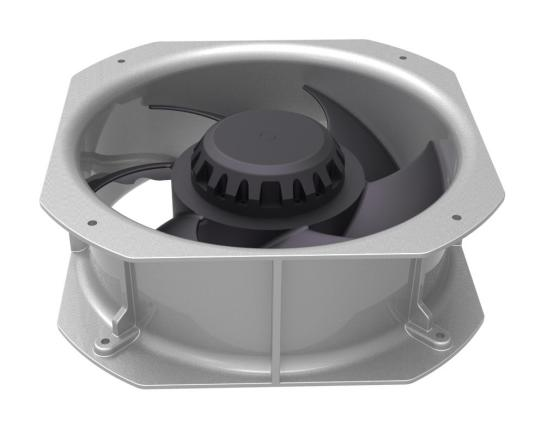
A prime example of this engineering standard is the 200mm A200P A005 AC Axial Fan. Models in this specific performance tier typically run on 220V or 240V grids, drawing around 65W of power while delivering robust airflow. They are typically equipped with die-cast aluminum frames and precision-machined dual ball bearings. These bearings drastically reduce internal friction and extend the operational lifespan up to 50,000 hours in demanding conditions. By selecting a meticulously engineered 200mm unit, facility managers can achieve continuous, high-volume airflow while maintaining a direct, transformer-free connection to standard power grids.
When it comes to moving massive amounts of air reliably and affordably, the alternating current axial fan remains an undisputed industry standard. By leveraging a direct power connection, delivering exceptionally high airflow, and boasting extreme durability, these fans provide a foundational cooling solution. Complex digital alternatives simply struggle to match this reliability in harsh environments.
Choosing the correct model is not just a matter of convenience. It is a critical step in preventing costly equipment downtime and ensuring a safe, temperature-regulated working environment. We encourage facility managers and engineers to evaluate their current thermal load and upgrade their facility cooling systems today. Visit EBST Fans to explore our comprehensive catalog of high-quality cooling solutions. Find the exact specifications you need and request a customized quote for your next industrial project.
The operational lifespan of an AC axial fan is primarily determined by the type of bearing system utilized within the motor and the ambient temperature of the operating environment. Fans equipped with standard sleeve bearings typically offer a lifespan of 25,000 to 30,000 hours under optimal conditions. However, for industrial applications, dual ball bearing systems are the definitive standard. A high-quality ball bearing fan can operate continuously for 50,000 to 70,000 hours, which is approximately 5.5 to 8 years of non-stop operation, at a standard temperature of 40 degrees Celsius. It is important to note that elevated ambient temperatures will accelerate the degradation of the bearing lubricant, incrementally reducing the overall life expectancy of the unit.
Yes, these fans can be successfully deployed in outdoor environments, provided they are manufactured with the appropriate Ingress Protection rating. The IP rating system classifies the degree of protection provided against the intrusion of solid objects like dust and liquids like rain. For outdoor use, an IP54 or IP55 rating is generally the minimum requirement. This offers robust protection against splashing water and harmful dust accumulation. For extreme outdoor environments subject to heavy rain or temporary submersion, engineers must specify fans with an IP67 or IP68 rating. These highly protected units often feature completely encapsulated motors and conformal-coated stators to prevent electrical short circuits and corrosion.
Acoustic noise is an unavoidable byproduct of moving large volumes of air, but the perceived loudness is highly variable. The noise level, measured in decibels, is influenced by the fan's rotational speed, the aerodynamic design of the impeller blades, and the physical size of the unit. Generally, smaller fans must spin at exceptionally high speeds to generate sufficient airflow, resulting in a high-pitched, whining noise. Conversely, larger fans can move the exact same volume of air while rotating at a much lower RPM. This produces a deeper, less intrusive humming sound. To mitigate noise in sensitive environments, engineers often select larger diameter fans and ensure they are mounted using anti-vibration rubber isolators.
Compared to miniature electronic cooling fans, industrial AC models draw more power, but their energy consumption is highly optimized relative to the massive volume of air they displace. Most standard models utilize shaded-pole motors or permanent split capacitor motors. While these traditional motor designs are slightly less energy-efficient than modern Electronically Commutated motors, they require zero external power conversion equipment. When evaluating the total cost of ownership, factoring in the low initial purchase price, the lack of expensive power supply units, and zero maintenance requirements, the electrical consumption of these fans remains highly cost-effective for large-scale, continuous ventilation applications.
The primary difference lies in their compatibility with the local electrical grid and the specific current draw of the motor, rather than their aerodynamic performance. A 115V fan and a 230V fan of the same size and wattage will move the exact same amount of air at the same speed. However, according to basic electrical principles, the 230V model will draw approximately half the electrical current compared to the 115V model to achieve the same power output. This lower current draw on 230V systems allows engineers to utilize thinner gauge wiring and reduces the overall thermal load on the facility's electrical breaker panels, making 230V highly preferable in heavy industrial settings.
Calculating the correct Cubic Feet per Minute for an electrical cabinet involves understanding the total heat dissipation of the internal components. First, determine the total watts of heat generated by all active electronics inside the enclosure. Next, decide on the maximum allowable temperature rise above the ambient room temperature. A standard engineering formula is: Airflow equals 3.16 times the total Watts, divided by the allowable temperature rise in degrees Fahrenheit. Always add a 20 percent safety margin to account for filter resistance and airflow blockages caused by dense cable routing.
Absolutely, provided you select a model specifically engineered for thermal endurance. Standard plastic impellers may warp or degrade when exposed to ambient temperatures exceeding 70 degrees Celsius. For high-heat applications such as foundries, commercial ovens, or heavy manufacturing exhaust, engineers must specify fans built entirely from metal. Units featuring die-cast aluminum frames, metal impellers, and high-temperature-rated dual ball bearings can comfortably operate in environments exceeding 100 degrees Celsius without suffering mechanical failure.


