


Views: 0 Author: Site Editor Publish Time: 2026-10-28 Origin: Site


When designing or upgrading a controlled environment, maintaining strict environmental parameters is an absolute necessity. From semiconductor manufacturing to pharmaceutical production, even the slightest fluctuation in airflow or particulate count compromises entire product batches. Facility engineers constantly evaluate aerodynamic and electrical efficiencies to optimize these critical spaces.
Electronically Commutated technology is rapidly becoming the industry standard for modern Fan Filter Units. Unlike traditional AC or DC alternatives, these advanced airflow solutions offer a unique combination of ultra-high energy efficiency, precise speed control, and a brushless design that prevents particulate contamination. This comprehensive guide explores exactly how these units function within controlled environments, the specific operational benefits they bring to HVAC systems, and how to choose the precise equipment for strict ISO-certified requirements.
Zero Contamination Risk: Utilizing advanced brushless motor technology, these units generate no carbon dust or microscopic particulate matter. This perfectly aligns with strict ISO-class standards.
Superior Energy Efficiency: Operating at significantly higher efficiencies than traditional AC alternatives, these units substantially reduce the massive electrical expenditures associated with continuous facility operations.
Precise Airflow Control: Integrated smart controllers enable micro-adjustments in rotational speed. This maintains optimal laminar flow and stable pressure differentials at all times.
Low Heat Dissipation: Highly efficient internal electronics mean the motors run exceptionally cool. This directly reduces the secondary sensible cooling load on the central chilling infrastructure.
Ideal for FFU Integration: The compact footprint and high static pressure capabilities make these units the optimal engineering choice for extensive filter networks.
To objectively determine whether specific ventilation equipment is suitable for highly controlled environments, engineers must first analyze the underlying motor mechanics. The distinction between traditional Alternating Current units and Electronically Commutated units dictates their performance in critical applications.
This technology effectively bridges the gap between AC power distribution and DC motor efficiency. These motors connect to a standard AC mains supply. However, instead of running directly on alternating current, an onboard electronic module rectifies the AC voltage into DC voltage. A built-in microcontroller then precisely dictates the electrical pulses sent to the stator, driving the rotor with exact timing. Consequently, this closed-loop electronic control allows the motor to operate with ultra-high efficiency. It provides variable speed capabilities typically reserved for pure DC motors, completely eliminating the need for bulky external Variable Frequency Drives.
In contrast, traditional AC induction motors operate on a fixed frequency. Their speed is inherently tied to the grid frequency. To vary the speed of an AC unit, facilities must install external drives, which introduce electrical harmonics and acoustic noise. Furthermore, AC motors suffer from electrical slip and inherent inefficiencies. They convert a significant portion of their electrical input into waste heat rather than mechanical aerodynamic work. In a highly regulated space, this excess thermal output and lack of seamless control create systemic inefficiencies that disrupt delicate environmental balances.
Performance Metric | Traditional AC Fans | Electronically Commutated (EC) Fans |
|---|---|---|
Energy Efficiency | Typically 40% - 60% | Up to 90% at peak operation |
Speed Control | Requires external VFD; limited range | Built-in 0-10V or Modbus; seamless 0-100% control |
Heat Generation | High waste heat adds to chiller load | Ultra-low heat dissipation |
Acoustic Noise | High magnetic hum, especially at lower speeds | Exceptionally quiet operation across all speeds |
System Integration | Complex wiring and external contactors needed | Plug-and-play BMS integration |
High-tech manufacturing spaces do not merely filter air. They utilize sophisticated fluid dynamics to actively sweep potential contaminants away from critical zones. The mechanical prime mover in this entire process is the fan.
The backbone of modern facility architecture is the Fan Filter Unit ceiling grid. High-performance EC axial fans are frequently paired directly with High-Efficiency Particulate Air filters inside these units. The objective is to push air evenly through the dense filter media, creating a unidirectional, laminar airflow. This laminar flow acts as an invisible, continuous piston. It washes over workstations and pushes airborne particles down to raised floor grilles. The precise speed modulation ensures that air velocity remains perfectly uniform across the entire ceiling grid, preventing turbulent dead zones where particles could accumulate.
Specifically, these facilities are designed with cascading pressure zones. An ISO Class 5 core manufacturing room must maintain a higher positive pressure than the adjacent ISO Class 7 gowning room. This ensures that when a transfer door opens, air flows outward. As filters capture particles over months of operation, their aerodynamic resistance increases. Equipped with constant airflow programming and pressure sensors, modern motors automatically increase their RPM to overcome this rising resistance. This keeps the pressure differential perfectly stable without requiring manual intervention from facility staff.
For facility managers and system engineers at the decision-making stage, hardware selection must be justified by operational stability and Return on Investment. Upgrading to advanced motor technology provides measurable advantages across several key performance indicators.
Ventilation systems operate continuously. Even minor improvements in motor efficiency yield massive reductions in kilowatt-hour consumption over an annual cycle. According to fan affinity laws, reducing speed by just 20% drops energy consumption by nearly 50%. Because these motors maintain high electrical efficiency even at partial loads, they are uniquely suited for variable-demand environments. This drastically lowers operational expenditures.
Thermodynamics play a crucial role in facility management. Every watt of electrical energy consumed by an inefficient motor that is not converted into airflow is dissipated as heat. This motor heat gain must be actively removed by the central chilling plant. Operating at efficiencies often exceeding 80%, these advanced motors introduce significantly less sensible heat into the airstream. This dual-saving effect maximizes overall energy performance by consuming less electricity at the fan level and requiring less cooling power at the chiller level.
Analyzing recent industry developments reveals a rapid paradigm shift in HVAC design for critical environments. Driven by stringent sustainability targets and the rising costs of energy, there is a massive push toward decarbonization and intelligent facility management. The integration of IoT within infrastructure is transitioning from a luxury to a regulatory expectation. Modern facilities are actively moving away from static, energy-intensive legacy systems toward dynamic, demand-controlled ventilation architectures.
Furthermore, the global expansion of semiconductor fabrication plants and biotechnology labs has intensified the demand for hyper-efficient airflow management. In this context, the adoption of advanced EC axial fans is accelerating exponentially. Their native ability to interface with digital Building Management Systems perfectly aligns with the industry trajectory toward Industry 4.0. Real-time data analytics and automated micro-adjustments now dictate operations. Future-proofing a facility relies heavily on selecting modular, hyper-efficient aerodynamic components that adapt to changing environmental demands instantly.
The primary disqualifying factor for any piece of equipment in an ISO 14644-1 certified environment is its potential to shed particles. An airflow generator must never be a source of contamination.
Traditional DC motors rely on physical carbon brushes to transfer electrical current to the spinning rotor. Over continuous operation, mechanical friction causes these brushes to degrade, releasing millions of microscopic carbon particles into the air. This makes brushed motors strictly prohibited. Conversely, electronic commutation is entirely brushless. Sensors and microprocessors handle the phase switching. With no physical friction points other than the sealed ball bearings, the motor generates zero carbon dust. This easily satisfies the stringent particulate limits of ISO Class 1 through ISO Class 5 environments.
Facilities undergo rigorous sterilization protocols, often involving harsh chemicals like Vaporized Hydrogen Peroxide or aggressive biocides. Equipment must withstand these treatments without oxidizing. Premium ventilation units are constructed using specialized materials, such as glass-fiber reinforced plastics and advanced polymer composites. These smooth, non-porous surfaces prevent microbial adhesion and are easily sanitized during routine washdowns.
The transition to modern automation architectures requires infrastructure to be intelligent, interconnected, and highly responsive. Advanced motor technology natively supports these data-driven environments.
Unlike traditional units that require complex external contactors, modern units feature integrated control interfaces. Facility engineers can easily connect these units to a central Building Management System. Speed control is managed via a simple 0-10V analog signal or through digital communication protocols like Modbus RTU. In a large space with hundreds of filter units, Modbus allows engineers to daisy-chain the communication wiring. This enables the system to address each unit individually, creating customized airflow zones based on real-time occupancy or particle counter data.
Unexpected mechanical failure results in massive financial losses and facility downtime. Smart motors provide bi-directional communication. They do not just receive speed commands; they transmit operational data back to the control center. Facility managers can monitor real-time parameters such as current power draw, rotational speed, and internal motor temperature. By establishing baseline data, the system flags anomalies instantly. A sudden spike in power consumption indicating a clogged filter allows maintenance teams to perform targeted interventions before a catastrophic failure occurs.
Selecting the correct ventilation hardware requires a meticulous engineering approach that goes beyond simply looking at maximum airflow volume. The unique aerodynamic resistance of dense filters dictates strict selection criteria.
A common engineering oversight is selecting equipment based solely on its free-air volumetric rating. Air must be forced through densely pleated filters, which create significant static pressure. If a unit cannot generate sufficient static pressure, the actual airflow plummets once installed in the ceiling grid. Engineers must consult the performance curve to ensure the operating point falls squarely within the peak efficiency zone.
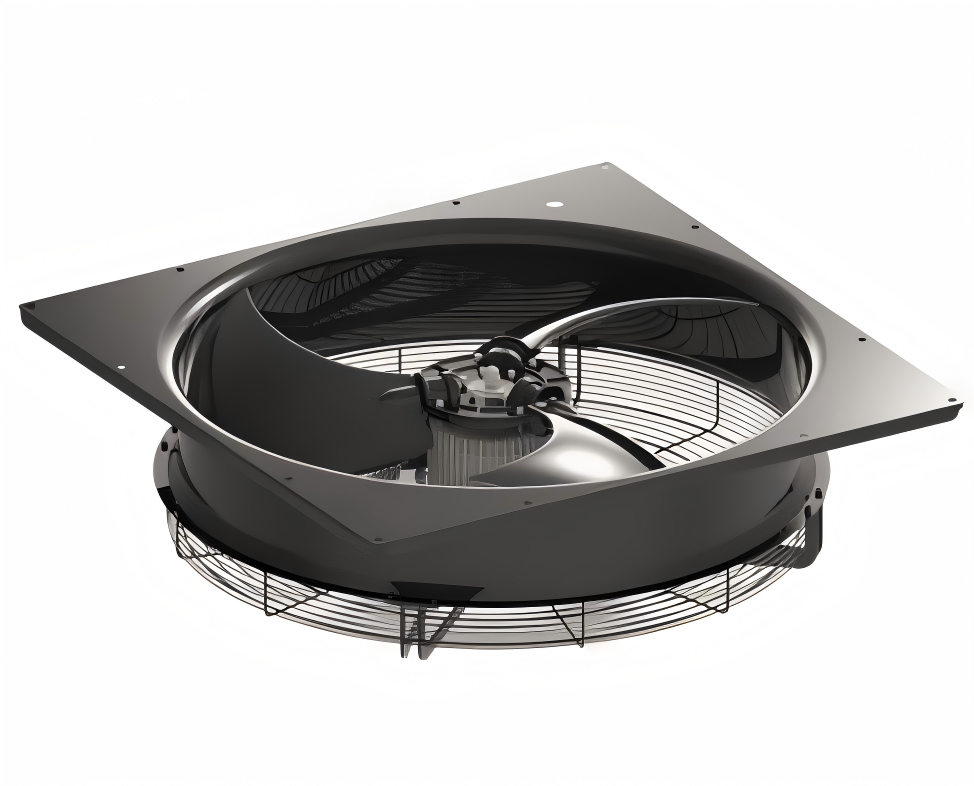
Depending on the scale of the facility, varying diameters are required to move massive volumes of air efficiently. Large-scale industrial spaces often demand robust, high-diameter solutions. For instance, selecting equipment like the NP-E Series EC800-910-1000mm Axial Fan provides a strategic engineering advantage. The use of advanced nylon reinforced with fiberglass results in an impeller that is exceptionally lightweight yet structurally rigid. This low-inertia design means the motor expends less energy accelerating the blades. It enhances overall system efficiency while maintaining the high static pressure required to penetrate deep-pleated filtration media.
The rigorous engineering principles behind electronically commutated technology make these units the trusted standard in some of the most highly regulated environments globally.
The production of silicon wafers occurs in ISO Class 1 to Class 3 environments, where a single particle of dust can short-circuit a nanoscale transistor. In these massive fabrication plants, thousands of filter units form the entire ceiling structure. Here, EC axial fans with nylon impellers are utilized to ensure zero-defect manufacturing. They provide the exact laminar flow needed while keeping electrical interference and structural vibrations to an absolute minimum, safeguarding highly sensitive photolithography equipment.
In the life sciences sector, spaces are designed to prevent biological and chemical contamination. Aseptic processing areas and sterile packaging zones rely on strict positive-pressure environments to comply with FDA regulations. The brushless, clean-running nature of these units ensures no foreign particulates are introduced into the sterile field. Simultaneously, their smart controls easily adapt to the changing resistance of complex bag-in/bag-out filter systems used in hazardous compounding.
While not traditional sterile environments, modern hyperscale data centers share highly similar requirements. They require strict dust control, precise thermal management, and massive volumes of high-efficiency airflow to cool server racks. The unmatched energy savings and continuous-duty reliability of this technology have made them the default choice for precision cooling infrastructure worldwide.
Advanced electronically commutated ventilation units are not just an acceptable option; they have evolved into the optimal engineering solution for modern facility design. By offering unparalleled energy efficiency, zero-particulate brushless operation, low heat emission, and seamless system integration, these units solve the most pressing fluid dynamics challenges faced by engineers today. Whether retrofitting an older laboratory or designing a state-of-the-art ISO Class 1 environment from scratch, investing in high-quality aerodynamic technology is a strategic decision. It guarantees regulatory compliance, slashes long-term operational costs, and protects critical manufacturing processes.
Ready to optimize your facility's airflow and energy efficiency? Explore our full range of high-performance ventilation solutions and find the exact specifications for your project at EBST Fans today.
From a strict capital expenditure perspective, the initial procurement cost is generally higher than that of a conventional AC unit. This price differential is due to the integration of advanced onboard electronics, the AC-to-DC conversion circuitry, and the precision engineering of the brushless motor. However, evaluating the cost solely on the purchase price is a flawed metric for industrial facilities. Facility managers must conduct a Lifecycle Cost Analysis. Because these motors operate at efficiencies of 80% to 90%, the reduction in electricity consumption is substantial. Empirical data shows that the return on investment through energy savings typically offsets the higher initial cost within 12 to 24 months. After this payback period, the operational expenditure is permanently reduced.
Yes, retrofitting legacy AC systems with modern technology is a highly viable and common engineering practice. Manufacturers design many modern units to be mechanically backward-compatible, matching the standard dimensions, bolt patterns, and mounting plates of older units. This allows for direct plug-and-play mechanical installation into existing housings. Electrically, the transition is equally streamlined. Because the essential rectification occurs entirely within the integrated electronics of the motor itself, the unit accepts the facility's existing alternating current power supply. You do not need to install external DC power supplies or rewire the primary electrical grid of the building.
The operational lifespan significantly exceeds that of traditional brushed AC or DC motors. The primary failure points in conventional motors are the physical brushes and thermal degradation of the copper windings due to excessive heat generation. Modern units are entirely brushless, completely eliminating mechanical friction and the associated wear. Furthermore, their high electrical efficiency means very little energy is wasted as heat. The motor runs considerably cooler, which drastically reduces thermal stress on the internal ball bearings and electronic components. Under standard operating conditions, high-quality models frequently achieve a life expectancy exceeding 50,000 to 70,000 hours of continuous, non-stop operation.
While the primary power input utilizes standard AC electrical wiring, accessing the intelligent control capabilities requires a secondary low-voltage connection. The specific wiring depends on the control protocol chosen by the facility engineers. The most common analog method is a simple 0-10V DC control signal or a Pulse Width Modulation signal. By varying the voltage on this single wire, the management system commands the unit to operate anywhere from 0% to 100% of its maximum RPM. For more advanced digital integration, many units support RS485 communication utilizing the Modbus RTU protocol. This digital network allows engineers to daisy-chain multiple units together on a single communication bus for precise, centralized control.
High-efficiency filters are inherently restrictive, and their resistance to airflow increases dynamically as they capture airborne particulates over months of operation. In a legacy AC system, this increased resistance causes a direct drop in volumetric airflow, potentially compromising the required air change rates and ISO classification. Advanced units solve this critical issue through integrated closed-loop control systems. Engineers can install differential pressure transmitters across the filter media and connect them directly to the onboard controller. Utilizing an internal PID algorithm, the unit operates in a constant volume mode. As the sensor detects a drop in airflow due to filter clogging, the controller automatically commands the motor to increase its RPM, generating higher static pressure to overcome the added resistance and maintain a perfectly stable environment.
Upgrading to brushless motor technology directly supports and protects ISO certification. To maintain classifications like ISO Class 3 or ISO Class 5, a facility must prove that airborne particulate concentrations remain below strict thresholds. Because electronically commutated motors lack carbon brushes, they produce zero mechanical dust during operation. Furthermore, their ability to maintain exact, unwavering airflow volumes ensures that the required Air Changes Per Hour are consistently met, which is a critical metric evaluated during the certification and validation process.
The Return on Investment for retrofitting a facility depends on the local cost of electricity and the operational hours of the HVAC system. However, in a typical 24/7 manufacturing environment, the energy savings are profound. By eliminating the massive heat waste of AC motors and utilizing fan affinity laws to run at optimized partial speeds, facilities often see a 40% to 50% reduction in ventilation energy costs. Consequently, the typical ROI timeframe ranges between 12 to 24 months. Beyond energy savings, the reduced load on the central chillers and lower maintenance costs further accelerate the payback period.


