


Views: 0 Author: Site Editor Publish Time: 2026-10-28 Origin: Site


Modern HVAC, refrigeration, and industrial cooling systems run on advanced motor technologies. Facility managers love the unmatched energy efficiency and precise speed control these systems offer. Yet, this shift introduces a hidden operational challenge. Electronically commutated motors rely on built-in controllers and high-speed switching circuits. This rapid electrical switching naturally generates Electromagnetic Interference, commonly referred to as EMI.
For many facility engineers, introducing electrical noise into a highly sensitive environment raises a massive red flag. Is this interference an undeniable physical reality? Yes. Is it highly manageable? Absolutely. This comprehensive guide breaks down exactly what causes electromagnetic noise in EC Axial Fans. We will explore how it impacts surrounding infrastructure and how top-tier manufacturers engineer their equipment to neutralize these disturbances.
Whether you are a procurement specialist sourcing components for a data center or an engineer upgrading a medical facility, understanding these dynamics is crucial. Your next cooling investment must enhance aerodynamic performance without disrupting critical electronics.
Inherent Noise Generation: The primary source of interference in modern cooling solutions is the high-frequency switching of internal electronic components like inverters and microcontrollers.
Two Propagation Paths: Conducted noise travels backward through physical power cables. Radiated noise broadcasts through the air as invisible electromagnetic waves.
Engineered Mitigation: High-quality equipment features built-in Electromagnetic Compatibility filters, effective physical shielding, and strict grounding protocols to trap electrical noise.
Regulatory Compliance: Meeting CISPR, FCC, and EN regulations is a non-negotiable step when selecting cooling units for sensitive environments like telecommunications hubs or automated manufacturing floors.
The HVAC and refrigeration sectors are currently undergoing a massive digital transformation. As facilities increasingly integrate smart building ecosystems, the density of low-voltage internet-of-things sensors placed right next to cooling units has skyrocketed. This proximity changes the game entirely. Historically, engineers focused purely on airflow and power consumption. Today, the electromagnetic footprint of a motor dictates facility-wide network stability.
Furthermore, the ongoing push for higher motor efficiency requires faster switching frequencies in the motor controllers. While this maximizes energy savings, it inherently increases the potential for both conducted and radiated noise. Consequently, managing this interference is no longer a niche engineering concern. It has become a primary baseline for modern infrastructure design, pushing manufacturers to innovate better shielding and filtration technologies.
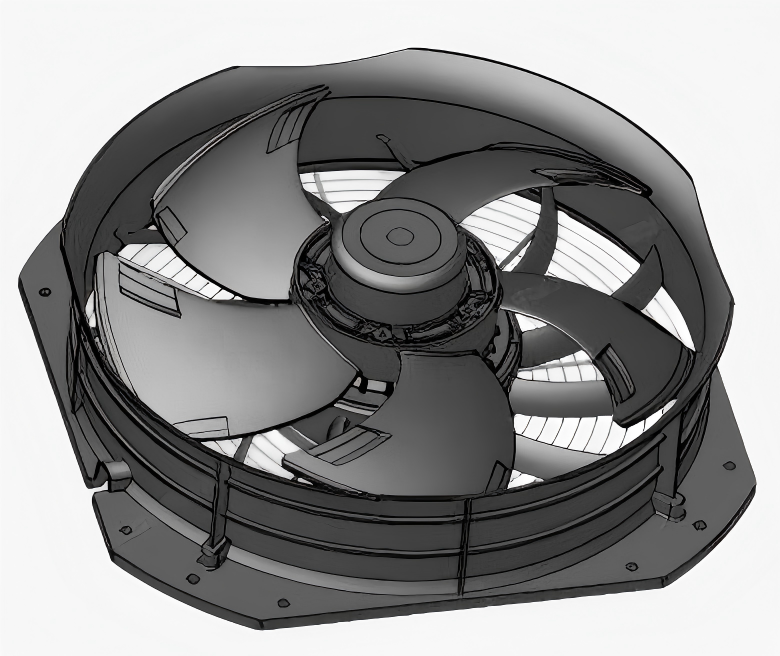
To grasp why these motors generate electrical noise, we need to look under the hood. Traditional induction motors operate directly from the mains power supply. They utilize the standard frequency of the alternating current to drive rotation. They are mechanically simple but lack dynamic control. In stark contrast, modern EC Axial Fans fuse an alternating current power input with a highly efficient brushless direct current motor. An onboard electronic commutation circuit acts as the intelligent brain of the unit.
This integrated circuit board performs two vital operations. First, it utilizes a rectifier to convert the incoming alternating voltage into a stable direct current voltage. Next, a microprocessor chops this voltage into precise, rapid pulses. Engineers call this technique Pulse Width Modulation. By continuously adjusting the width of these pulses, the controller precisely regulates motor speed. This mechanism unlocks exceptional energy savings and adaptive airflow.
However, this sophisticated control mechanism is the exact origin of the electromagnetic footprint. The onboard transistors function as electronic switches. They turn the electrical current on and off thousands of times per second. These rapid events create sharp, instantaneous changes in voltage and current. Specifically, these steep electrical transitions contain high-frequency harmonic energy. If left unchecked, this energy escapes the circuit board as electromagnetic noise.
When the internal electronics generate high-frequency harmonic energy, that noise inevitably seeks an exit path. Within industrial and commercial cooling frameworks, this interference propagates through two distinct pathways. Each requires a completely different mitigation strategy.
Conducted noise refers to the high-frequency electrical interference that travels backward into the main power supply via the physical power cables. Because the motor is hardwired to the facility grid, the switching noise generated by the controller can easily flow upstream along the wiring.
This type of interference is typically measured in the frequency range of 150 kilohertz to 30 megahertz. It is further segmented into Differential Mode noise flowing between the line and neutral conductors, and Common Mode noise flowing between the power conductors and the earth ground. Without robust filtration, this conducted noise pollutes the local electrical grid. It can easily destabilize other sensitive devices plugged into the same power circuit.
Conversely, radiated noise occurs when the internal circuitry and unshielded connecting cables act like miniature transmitting antennas. Rather than traveling through physical copper wires, the high-frequency energy broadcasts outward as invisible waves into the surrounding air.
Radiated emissions generally occur at higher frequencies, typically above 30 megahertz. The rapid switching of the motor coils and the high-frequency currents traversing the circuit board create fluctuating magnetic and electric fields. This airborne interference can easily penetrate the plastic enclosures of nearby equipment. Consequently, it disrupts wireless communication signals and confuses delicate environmental sensors.
Imagine a facility manager troubleshooting a mystery data drop in a server rack, only to discover the culprit is unshielded radiated noise from a newly installed cooling unit. I have seen this happen on multiple job sites. In industrial automation environments, airborne noise can induce false voltages in the wiring of Programmable Logic Controllers. This triggers unwarranted system shutdowns and halts production lines. The stakes climb even higher in medical facilities. High-frequency noise can corrupt the delicate signals processed by MRI machines or patient monitoring systems, resulting in dangerous visual artifacts on imaging screens.
Beyond immediate equipment malfunction, conducted noise actively degrades overall facility power quality. Harmonic distortion pushed back into the grid by multiple unfiltered EC Axial Fans distorts the standard sinusoidal waveform of the power supply. Over time, this dirty power causes excessive heat buildup in facility transformers. It accelerates the degradation of cable insulation and drastically lowers the operational lifespan of connected power supplies. For procurement teams, ignoring these factors often leads to failed regulatory audits and exorbitant post-installation retrofits.
Regulatory bodies worldwide have established strict guidelines to prevent electronic devices from turning a facility into a chaotic web of interference. Before diving into specific regulations, we must distinguish between two frequently confused terms. EMI is the disruptive electrical noise generated by the switching circuitry. EMC, or Electromagnetic Compatibility, is the engineering solution. A device with excellent compatibility operates reliably in its shared environment without causing unacceptable disturbances, while remaining immune to external interference.
When evaluating cooling equipment, verifying compliance with regional and international standards is a non-negotiable step:
Europe: Products must comply with the EN 61000 series. The EN 61000-3-2 standard dictates strict limits for harmonic current emissions injected back into the public supply. Meanwhile, EN 61000-6-3 outlines emission standards for residential and commercial environments, ensuring radio-frequency disturbances remain below disruptive thresholds.
North America: The Federal Communications Commission Part 15 regulations govern electromagnetic emissions in the US. Industrial equipment typically must meet Class A limits. Commercial or residential settings demand stricter Class B limits to protect wireless communications.
International: The International Special Committee on Radio Interference provides the global baseline. CISPR 11 applies to industrial, scientific, and medical equipment, setting clear boundaries for both conducted and radiated emissions.
Compliance is not merely a legal checkbox. It is a testament to engineering integrity. Buyers should routinely request official test reports from certified third-party laboratories to ensure the equipment will not compromise their existing electrical ecosystem.
The presence of switching electronics means that noise generation is an inherent physical trait of modern motor technology. To counter this, top-tier manufacturers employ highly sophisticated engineering techniques. They neutralize interference before it ever breaches the fan housing.
The primary defense against conducted noise is the integration of electronic filter networks directly onto the printed circuit board. Premium units utilize a strategic combination of passive components to trap high-frequency noise. X-capacitors are placed across power lines to suppress differential-mode noise. Y-capacitors address common-mode noise bridging the power lines and ground. In addition, specialized magnetic inductors act as a roadblock. They allow standard alternating current power to flow freely while presenting massive resistance to the high-frequency switching noise, effectively scrubbing the power line clean.
To combat airborne radiated noise, engineers rely on physical shielding based on the Faraday cage principle. The electronic controller is typically encased within a grounded metal housing or a high-density polymer treated with conductive coatings. When electromagnetic waves generated by the internal transistors strike this conductive barrier, they are immediately absorbed or reflected. This encapsulation prevents the noise from escaping into the surrounding environment, safeguarding nearby wireless signals and delicate sensors.
The physical architecture of the motor itself plays a pivotal role in electromagnetic compatibility. Advanced stator designs are meticulously crafted to minimize magnetic flux leakage and parasitic capacitance. Furthermore, establishing a robust grounding path is absolutely critical. Proper earthing ensures that any stray electromagnetic energy captured by the internal shielding is safely directed into the ground, rather than radiating outward or coupling onto adjacent communication cables.
When facility managers map out infrastructure upgrades, they frequently weigh the electromagnetic profiles of traditional fans against modern alternatives. This comparison highlights a distinct technological trade-off.
Traditional induction fans operate on a remarkably simple electromechanical principle, drawing current directly from the grid to create a rotating magnetic field. Lacking complex microprocessors or high-frequency inverters, they generate virtually zero high-frequency noise. Aside from a low-frequency magnetic hum, they are inherently quiet from an electrical standpoint. Conversely, electronically commutated fans rely entirely on rectification and rapid switching, creating a high baseline potential for both conducted and radiated interference.
If built without proper filtration, modern motors would undoubtedly cause severe grid pollution. However, this raw potential is a calculated trade-off. The integration of digital commutation allows these modern fans to achieve massive energy efficiency, precise variable speed control, and significantly extended operational lifespans.
Here is a direct engineering comparison to guide your selection:
Feature | Traditional AC Fans | Modern EC Axial Fans |
|---|---|---|
Energy Efficiency | Moderate to Low | Extremely High up to 70 percent savings |
Speed Control | Limited, often requires external drives | Precise, built-in adaptive control |
Inherent EMI Generation | Very Low magnetic hum only | High due to rapid switching circuits |
EMI Mitigation Strategy | Not typically required | Requires built-in EMC filters and shielding |
Best Application Environment | Basic ventilation with low tech density | Data centers, medical labs, smart HVAC systems |
To bridge this gap, reputable manufacturers engineer their modern units with comprehensive filters and robust shielding. With these advanced mitigations in place, the electrical noise is effectively neutralized, bringing the profile well within strict regulatory limits.
Procuring cooling equipment for mission-critical environments requires meticulous attention to detail. Overlooking electrical noise ratings during the purchasing phase inevitably leads to costly system downtimes. Utilize the following concrete criteria to ensure a seamless, compliant integration.
First, rigorously scrutinize the technical specifications. Never assume a product is safe simply because it utilizes modern technology. Look for explicitly stated compliance standards, such as EN 61000-6-3 or FCC Part 15 Class B. If the documentation lacks clear harmonic distortion limits, consider it a major red flag and walk away.
Next, evaluate the material and build quality. The physical construction directly impacts electromagnetic containment and long-term durability. For instance, selecting robustly engineered models like the NP-A-E Series EC 450mm Axial Fan with Nylon Impeller demonstrates how manufacturers successfully balance secure electronic shielding with lightweight, aerodynamic components. A well-sealed, properly grounded motor housing is essential for reliable, low-noise operation.
Finally, prioritize application matching. An agricultural ventilation system has a vastly different tolerance for electrical noise compared to a hospital imaging room or an automated manufacturing floor. Consult with technical sales engineers to ensure the specific profile of the unit aligns perfectly with the sensitivity requirements of your unique facility.
While electromagnetic interference is an inherent byproduct of modern cooling technology, it is a highly manageable and well-understood phenomenon. The internal switching electronics naturally generate high-frequency electrical noise. However, premium built-in filters and robust conductive enclosures effectively trap this interference at the source. Consequently, quality EC Axial Fans easily meet strict global electrical compliance standards, ensuring safe and reliable operation even in the closest proximity to highly sensitive equipment.
Facility managers and procurement teams can upgrade their infrastructure with absolute confidence. The massive energy savings, reduced acoustic noise, and precise adaptive control provided by advanced motors far outweigh any easily mitigated concerns. Ready to upgrade your facility cooling infrastructure without compromising electrical stability? Explore high-performance, fully compliant solutions tailored for sensitive environments and find the perfect match for your project at ebstfans.com today.
From a purely physics standpoint, yes. All units utilizing this technology generate some level of noise due to the rapid switching of their internal microcontrollers and transistors. However, high-quality models are engineered with sophisticated built-in passive and active filters that suppress this interference, reducing it to levels well below strict international regulatory limits.
Conducted and radiated noise often manifest in subtle, frustrating ways. Common operational signs include flickering displays on nearby monitors, unexplained data packet loss in IT communication lines, erratic or fluctuating sensor readings in industrial automation, or buzzing noises in audio equipment sharing the same power circuit.
Yes. While premium units already feature robust internal filtration, certain hyper-sensitive environments such as hospital MRI rooms, aerospace testing laboratories, or specialized telecommunications hubs may require ultra-low noise thresholds. In these scenarios, facility engineers can install external line filters directly on the main power supply line to provide an additional layer of noise suppression.
The impeller material itself does not have a direct impact on the generation or suppression of electromagnetic interference. A nylon impeller primarily benefits the system by reducing overall weight, improving aerodynamic efficiency, and lowering acoustic noise. The motor electronic circuit board exclusively generates the electrical noise, and the physical shielding around the motor housing mitigates it, not the fan blades.
If multiple unshielded, non-compliant units are installed, the cumulative conducted noise and harmonic distortion can severely degrade the overall facility power quality. Over time, this dirty power causes excessive heat buildup in transformers, accelerates the degradation of cable insulation, and leads to the premature failure of other electronic devices connected to the same grid.
Facility engineers typically use a spectrum analyzer paired with near-field probes to detect radiated emissions around the equipment housing. For conducted emissions, a Line Impedance Stabilization Network is connected between the power supply and the cooling unit to measure the noise feeding back into the grid. If you suspect interference, hiring a certified technician to perform a site power quality audit is the most accurate approach.
These terms are often confused but represent two sides of the same coin. EMI is the actual disruptive electrical noise generated by the rapid switching of the motor controller. EMC is the engineering solution designed into the fan. A fan with good electromagnetic compatibility contains and neutralizes its own noise while remaining immune to outside electrical disturbances.


