


Views: 0 Author: Site Editor Publish Time: 2026-10-28 Origin: Site


Modern electronics and industrial machinery face a critical bottleneck: thermal management. Engineers constantly push the boundaries of miniaturization. They pack massive processing power into incredibly tight enclosures. Consequently, the heat density within these systems skyrockets. Overheating directly degrades components. Without precise thermal regulation, sensitive equipment will inevitably fail. This leads to significantly reduced operational lifespans and costly unplanned downtime. For enterprise data centers, medical facilities, and automated manufacturing plants, thermal failure is not merely an inconvenience. It is a substantial financial and operational liability.
Enter the DC axial fan. Veteran engineers regard it as the frontline defense for thermal regulation. This highly efficient cooling solution is specifically engineered to move massive volumes of air through restricted spaces. It dissipates heat well before system integrity is compromised. This comprehensive guide breaks down the mechanics of these electromechanical devices. We will explore their core benefits over traditional cooling methods, highlight key industrial applications, and provide a technical roadmap for your next engineering project.
The current trajectory of thermal management can be summarized in one phrase: small yet mighty. We are witnessing an explosive growth in Edge Computing, Internet of Things devices, and localized artificial intelligence processing. Enterprise-grade computing power is rapidly migrating out of massive climate-controlled data centers and into rugged remote enclosures. These edge devices face extreme environmental fluctuations. They demand highly reliable localized cooling to survive.
Similarly, the rapid expansion of Electric Vehicle infrastructure requires compact power electronics capable of handling massive electrical loads. As the heat density in these applications breaks new records, thermal management shifts from an afterthought to a primary design constraint. The industry is actively responding. Manufacturers are engineering highly optimized direct current axial fans that deliver unprecedented static pressure within smaller form factors. This proves that immense cooling potential can indeed be packaged into intelligent compact designs.
To fully grasp the value of modern thermal management, we must examine the fundamental mechanics of cooling devices. A direct current axial fan operates on a straightforward but highly effective aerodynamic principle. The fan blades are precisely angled to draw air in parallel to the central rotational axis. The air is then forced out in the exact same parallel direction. This straight-line air movement creates a direct high-volume stream. It is highly effective for cooling heat-generating components situated directly in the air path.
Advanced brushless DC motor technology powers these cooling units. Older fan designs relied on mechanical brushes rubbing against a commutator to transfer electrical current. Modern units utilize electronic commutation instead. The internal mechanism consists of a stationary stator equipped with copper wire windings and a rotating rotor lined with permanent magnets.
Inside the motor hub, a printed circuit board equipped with Hall effect sensors detects the exact position of the rotor. The electronic controller systematically switches the current through the stator windings based on this telemetry. This creates a shifting magnetic field that pulls the rotor magnets along. Mechanical friction is virtually eliminated since there is no physical contact between moving parts. This lack of wear drastically reduces internal heat generation, prevents carbon dust accumulation, and extends the operational lifespan of the motor significantly.
Alternating current fans were the standard for industrial cooling for decades. Today, the modern engineering landscape is rapidly shifting toward direct current solutions due to verifiable performance metrics. DC models convert electrical power to rotational energy with far greater efficiency.
Performance Metric | AC Axial Fan | DC Axial Fan |
|---|---|---|
Power Consumption | High energy draw, significant heat waste | Up to 70% lower power consumption |
Speed Control | Limited, requires complex inverters | Highly precise via Pulse Width Modulation |
Electromagnetic Interference | High interference risk | Very low, safe for sensitive electronics |
Operational Lifespan | Moderate | Extended significantly by brushless design |
Voltage Options | 110V, 220V standard | 12V, 24V, 48V tailored for electronics |
This transition is largely driven by empirical data. DC technology not only reduces long-term electricity costs but also protects sensitive surrounding components from signal disruption.
Procurement managers and system engineers evaluate cooling components based on strict criteria. Airflow capacity, energy draw, and acoustic output are the baseline metrics. Integrating a high-quality 180mm DC axial fan into an equipment enclosure consistently meets these benchmarks. This provides distinct operational advantages across various hardware configurations.
Space constraints are a universal challenge in modern product design. Routing thick cables through a cramped 1U server chassis or densely packed telecommunication box drastically reduces internal volume. DC axial fans feature highly optimized aerodynamic blade profiles. These swept-blade designs maximize the cubic feet per minute of air moved per rotation. By efficiently pulling cold air in and pushing hot air out, they disrupt thermal boundary layers. This prevents heat bottlenecks even when the physical footprint is strictly limited.
The integration of Pulse Width Modulation and tachometer outputs provides a massive technical advantage. A PWM-enabled fan does not run at a constant inefficient full speed. The system motherboard sends a digital square wave signal to the fan. This rapidly pulses the power on and off to control the RPM with extreme precision.
When internal thermistors detect low temperatures, the fan slows down. This reduces acoustic noise to a whisper and saves power. If a sudden temperature spike occurs during peak processing loads, the fan instantly ramps up to full capacity. The tachometer output relays real-time RPM data back to the controller simultaneously. This ensures the system can verify that the fan is operating correctly at all times.
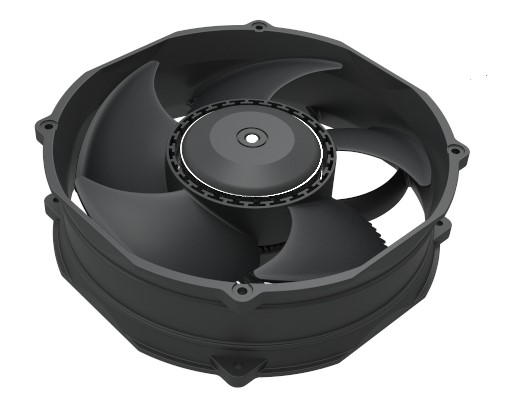
Selecting the correct physical dimensions for a cooling fan is a critical engineering decision. The size of the fan dictates the surface area of the blades. This directly correlates to the volume of air it can move and the acoustic noise it generates. While smaller fans are suited for compact electronics, larger industrial enclosures require a vastly different approach.
Standard 120mm fans often struggle to provide adequate airflow for medium-to-large industrial applications unless they spin at extremely high inefficient speeds. Massive 254mm fans may not fit inside standard enclosures. This unique spatial challenge makes the 180mm dimension an ideal sweet spot for engineers.
For example, a high-performance DC axial fan from ebstfans provides a significantly wider blade sweep. This increased surface area allows the fan blades to physically catch and push a massive volume of air with every single rotation. Consequently, it achieves high cubic feet per minute ratings without needing to operate at maximum voltage or RPM. This makes it a highly efficient choice for telecom cabinets, large heat exchangers, and industrial power supplies.
Evaluating internal components and environmental protections is necessary to ensure long-term compatibility and survival in the target environment.
Bearing Types: The mechanical bearing supporting the rotor shaft is the heart of the fan. Buyers must choose the correct bearing based on empirical data rather than upfront cost alone. Dual ball bearings consist of a ring of tiny steel balls surrounding the shaft. They create point-contact friction. They are the standard recommendation for high-temperature continuous industrial operation. They can be mounted at any angle without degrading their 50,000 to 70,000-hour lifespan.
Ingress Protection: Systems deployed outdoors or in factories prone to metal dust will short-circuit rapidly without proper protection. Buyers must verify the Ingress Protection rating of the fan. For extreme environments, an IP68 rating is mandatory. These fans feature a fully encapsulated motor using conformal coating or potting compound on the printed circuit board. They are completely dust-tight and capable of surviving continuous submersion in water.
Voltage Requirements: Matching the fan operating voltage to the primary power supply avoids electrical incompatibilities. 12V models are typically used in consumer electronics. The 24V standard dominates industrial automation panels and commercial HVAC control systems. Finally, 48V fans are utilized almost exclusively in telecommunications and enterprise data center server racks. Higher voltage allows for lower current draw over long cable runs, significantly reducing wire heating.
The versatility and reliability of brushless DC cooling have led to its rapid adoption across a wide spectrum of critical industries. Understanding where these thermal management solutions are successfully deployed helps procurement teams contextualize their own specific use cases.
Data centers and telecom base stations house hundreds of thousands of microprocessors. These components generate immense amounts of thermal energy. Servers are typically stacked in high-density racks where restricted airflow quickly leads to thermal throttling. This is a self-preservation process where CPUs artificially slow down to prevent melting. High-static-pressure fans are deployed in server power supplies, chassis exhausts, and hot-aisle containment systems. They ensure cold air is rapidly pulled over heat sinks and expelled efficiently.
The global transition to renewable energy and automated manufacturing relies heavily on robust power electronics. Solar inverters convert DC power from solar panels to AC power for the grid. This conversion process generates significant heat. In automated factories, programmable logic controllers and motor drives housed in sealed control panels must be kept cool to prevent factory downtime. When a factory floor hits 40°C in the summer, standard cooling fails. In these harsh scenarios, ruggedized fans provide the continuous cooling required to maintain system integrity.
Moving from technical specification to the final purchasing decision requires selecting a reliable manufacturing partner. A high-performance specification sheet is meaningless if the supplier lacks stringent quality control and production consistency. Procurement teams must prioritize manufacturers that subject their cooling products to rigorous environmental and electrical testing. Look for explicit certifications like Underwriters Laboratories and Conformite Europeenne to ensure strict fire, electrical safety, and environmental protection standards are met.
High-quality DC axial fans are absolute powerhouses when it comes to protecting expensive electronics and heavy machinery from heat damage. Choosing the correct physical size, operating voltage, and bearing type is critical to ensuring long-term operational success. By carefully matching airflow and static pressure to your specific enclosure geometry, you optimize both energy consumption and acoustic performance.
Evaluate your current thermal management needs today. For engineering teams seeking robust, customizable, and high-efficiency cooling solutions, explore the comprehensive product catalog at EBST Fans. Upgrade your system with a reliable 180mm cooling solution tailored to your exact project requirements to prevent costly unplanned system failures.
The lifespan depends largely on the internal bearing type and its operating environment. Ball bearing fans are highly durable and can last upwards of 50,000 to 70,000 hours, even in elevated temperatures. Sleeve bearing fans typically have a lifespan of around 30,000 hours and are better suited for cooler, less demanding environments where the fan is mounted vertically.
Yes, they can be successfully deployed in outdoor applications provided they feature the appropriate Ingress Protection rating. Fans rated IP67 or IP68 are specifically designed with encapsulated motors to protect sensitive internal electronics and stator coils from water immersion, heavy dust storms, and UV exposure.
Speed control is typically achieved in two ways. The most basic method involves manually altering the input voltage to the fan. However, the modern and highly precise method uses a fan equipped with Pulse Width Modulation. This allows the system controller to send digital signals to the fan, enabling automated real-time RPM adjustments based on direct thermal sensor feedback.
The primary difference lies in the airflow trajectory. Axial fans push air in a straight line parallel to the motor shaft. This makes them ideal for delivering high airflow in environments with relatively low resistance. Blowers, or centrifugal fans, draw air into the center and push it out at a 90-degree angle. Blowers are specifically designed to generate high static pressure for pushing air through highly restricted spaces like ductwork or dense heatsinks.
The 180mm size provides a massive surface area for air displacement. This large blade sweep allows the fan to cool large industrial enclosures efficiently by moving significant volumes of air with every rotation. Because it moves more air per revolution, it does not need to spin at the excessively high noisy speeds required by smaller fans. This results in excellent cooling performance with minimal acoustic disruption.
Matching the fan voltage to your system power supply is critical. 12V models are standard for consumer electronics and small medical devices. The 24V standard dominates industrial automation panels and commercial HVAC systems. Meanwhile, 48V fans are utilized almost exclusively in telecommunications and enterprise server racks. Higher voltage allows for lower current draw over long cable runs, which significantly reduces wire heating.
Premature failure is typically caused by severe dust accumulation, excessive ambient temperatures exceeding the bearing rating, or sudden voltage spikes. Utilizing fans with dual ball bearings and an appropriate Ingress Protection rating for dust and water resistance will drastically mitigate these risks and ensure continuous operation in harsh environments.


