


Views: 0 Author: Site Editor Publish Time: 2026-10-28 Origin: Site


In the high-stakes realm of aerospace engineering, equipment failure is simply not an option. Overheating remains a primary culprit behind avionics malfunctions. This makes reliable thermal management a critical flight safety imperative. Standard commercial electronics sit in climate-controlled rooms, but aircraft systems face a brutal gauntlet. They endure extreme temperature fluctuations, high-altitude pressure drops, intense multi-axis vibration, and strict power limitations. Standard cooling components will fail rapidly under these harsh flight conditions.
Consequently, the aerospace industry demands highly specialized cooling solutions. Systems engineers and procurement specialists must understand exact specifications, environmental standards, and performance metrics. This knowledge is essential to select a reliable DC axial fan. Properly specified hardware ensures flight control computers, radar arrays, and communication modules operate flawlessly from takeoff to touchdown.
Size, Weight, and Power: Constraints dictate that avionics cooling components must be highly efficient. They must be exceptionally lightweight to meet strict engineering tolerances without adding unnecessary payload.
Altitude Impacts Airflow: Decreased air density at high altitudes significantly reduces mass airflow. This demands a calculated over-specification at sea level to maintain cooling efficiency during cruising.
Durability is Non-Negotiable: Avionics enclosures require specialized dual ball bearings and high Ingress Protection ratings. Verified compliance with rigorous vibration and thermal shock standards is mandatory.
Electromagnetic Compatibility: Brushless technology is essential. It prevents electromagnetic interference and protects sensitive flight navigation systems from electrical noise.
Smart Controls Save Power: Advanced features like Pulse Width Modulation allow cooling units to adjust speeds dynamically based on thermal loads. This conserves critical aircraft battery reserves.
In modern aerospace architecture, the established electrical framework strictly dictates the power supply. Most commercial and military aircraft operate on a standard 28V Direct Current power bus. Integrating a DC-powered cooling solution is far more logical than attempting to convert Alternating Current power. Using AC components requires heavy and inefficient inverters. These inverters step down the native power of the aircraft, which adds unnecessary weight and introduces potential failure points. Furthermore, DC motors offer superior energy efficiency. They routinely consume up to 70 percent less power than their AC counterparts for the exact same aerodynamic output. This inherent efficiency allows for precise variable speed control. Such control is a critical function for avionics systems experiencing wildly fluctuating thermal loads during different phases of flight.
An axial design draws air in parallel to the axis of its rotating blades and expels it in the same linear direction. This straight-through airflow pattern is highly advantageous for cooling tightly packed electronic enclosures. The aerodynamic profile of the impeller moves large volumes of air with minimal turbulence. This establishes a consistent thermal gradient across sensitive microchips. Aircraft electronic components are frequently housed in cramped ARINC 404 or ARINC 600 chassis. Internal space here is at an absolute premium. High volumetric airflow is essential for flushing accumulated heat out of these confined bays. Centrifugal blowers change the air direction by 90 degrees and demand substantial physical clearance. The compact footprint of an axial unit makes it the undisputed industry standard for direct chassis cooling.
Industry Trend Analysis: The aerospace sector is rapidly accelerating toward the More Electric Aircraft trend. Aircraft manufacturers are actively replacing legacy hydraulic and pneumatic systems with advanced electrical alternatives. Consequently, the overall power density within avionics bays is skyrocketing. High-speed flight computers and Active Electronically Scanned Array radars generate unprecedented thermal loads. This ongoing industry shift drives a massive surge in demand for highly intelligent cooling solutions. Modern engineering requires components capable of dissipating extreme heat without expanding the physical footprint of the hardware.
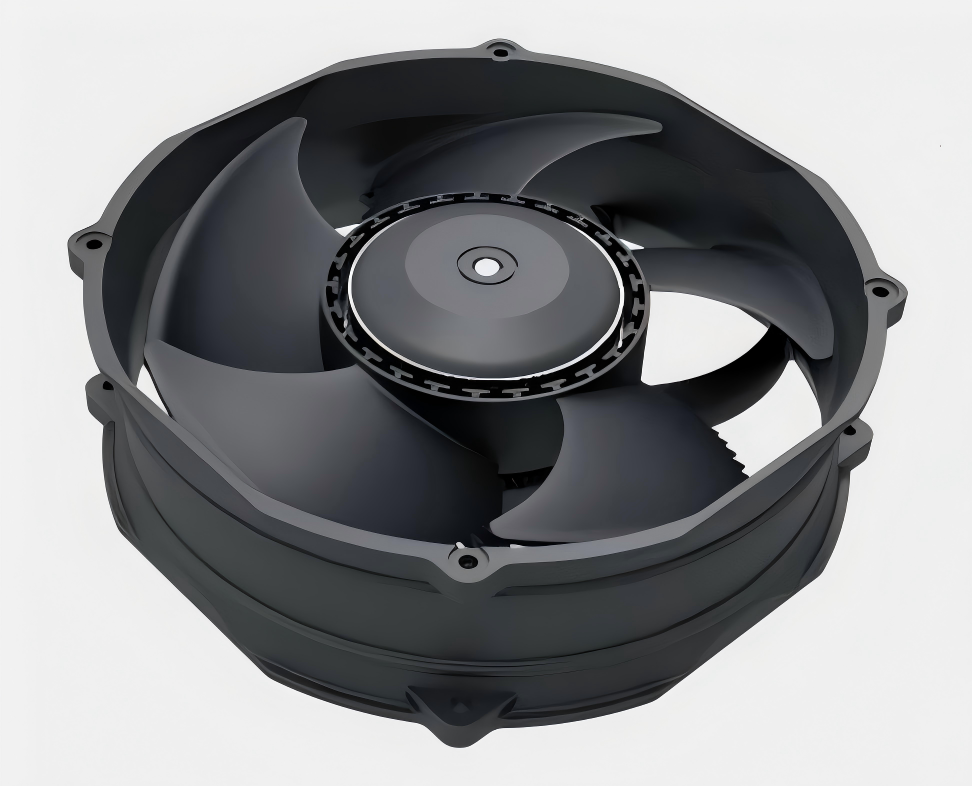
Every additional ounce of weight translates directly to increased fuel consumption and reduced payload capacity. Weight reduction correlates directly to extended flight ranges and lower operational costs over the lifespan of the airframe. Minimizing the mass of thermal management components remains a primary engineering objective. Modern aerospace cooling solutions utilize advanced materials to achieve this strict balance. For instance, selecting a DC axial fan with a nylon impeller provides a significant weight reduction compared to legacy steel or heavy die-cast components. High-grade polyamide nylon maintains excellent aerodynamic performance and structural integrity under high rotational stress. This satisfies stringent weight budgets without compromising cooling power.
Avionics bays are notoriously cramped environments. Systems engineers must meticulously fit navigation units, communication arrays, and flight control computers into highly restricted physical volumes. Cooling solutions must feature low-profile designs that maximize spatial efficiency. A standard unit offers a high airflow-to-volume ratio. This allows it to be mounted directly onto internal heat sinks or external enclosure panels. It does so without protruding into critical clearance zones or interfering with complex wire routing paths.
Aircraft power budgets are meticulously calculated and strictly enforced. Avionics systems simply cannot afford to waste electrical resources on inefficient cooling mechanisms. Brushless DC motors are paramount in this regard. They provide maximum airflow per watt of power consumed. By utilizing electronically commutated motors, these devices minimize internal electrical resistance and heat generation. The cooling system itself must never become a parasitic drain on vital electrical reserves. This leaves maximum power available for mission-critical flight instrumentation.
The primary function of any thermal management device is to reliably dissipate thermal energy. Engineers must calculate the required Cubic Feet per Minute based on the maximum heat load and the allowable temperature rise within the enclosure. Establishing a precise thermal baseline ensures the selected component can maintain safe operating temperatures under peak processing loads. This actively prevents thermal throttling. Specifically, engineers must account for the layout of internal components. The airflow path must remain unobstructed so heat-generating processors receive the maximum cooling breeze.
While volumetric flow measures the sheer volume of air moved, static pressure measures the mechanical force required to push that air through resistance. Avionics boxes are typically densely packed with printed circuit boards, dense heat sink fins, and restrictive electromagnetic filters. This creates significant airflow impedance. A cooling unit with high static pressure capabilities is strictly required to overcome this internal resistance. If a unit lacks sufficient static pressure, the actual delivered airflow will drop drastically. This inevitably leads to localized hot spots and potential component failure.
Standard commercial cooling devices are rated based on air density at standard sea level conditions. Avionics systems operate at altitudes where air density is significantly lower. At 30,000 feet, the ambient air is much thinner. The impeller moves substantially less mass of air per rotation. Convective heat transfer relies heavily on air mass, so this directly reduces the cooling capacity. Engineers must apply an altitude derating factor. You must effectively over-specify the nominal airflow at sea level to guarantee adequate thermal management at maximum cruising altitudes.
Altitude in Feet | Air Density Ratio | Required Airflow Multiplier |
|---|---|---|
Sea Level | 1.00 | 1.00x |
10,000 | 0.74 | 1.35x |
20,000 | 0.53 | 1.88x |
30,000 | 0.37 | 2.70x |
40,000 | 0.25 | 4.00x |
An aircraft experiences rapid and extreme temperature fluctuations during a standard operational cycle. A system might sit on a sun-baked tarmac in 50 degrees Celsius ambient heat. It will then rapidly ascend to a high-altitude environment where outside temperatures plunge below negative 50 degrees Celsius. To survive these harsh transitions, a robust DC axial fan designed for avionics must be rated for wide operating temperatures. In addition, the impeller and frame materials must withstand intense thermal shock without cracking, warping, or becoming brittle. The expansion and contraction of materials during these thermal cycles must be carefully managed through precise engineering tolerances.
Flight operations generate continuous, multi-axis vibration from engine resonance, atmospheric turbulence, and hard landing impacts. Standard sleeve bearings rely on a thin film of liquid lubricant. They will quickly dry out or leak under these harsh dynamic conditions. Aerospace standards dictate the strict use of precision dual ball bearing systems. Ball bearings lock the rotor shaft securely in place. This prevents wobbling and ensures longevity even when subjected to rigorous vibration profiles like RTCA DO-160 testing protocols.
Moisture, condensation, and particulate dust are constant threats to avionics hardware. As an aircraft changes altitude and passes through varying weather fronts, condensation easily forms inside unsealed enclosures. Avionics fans require robust environmental protection to prevent electrical short circuits and long-term corrosion. High Ingress Protection ratings are standard requirements in the aerospace industry. This level of defense is typically achieved through specialized conformal coatings or complete resin potting of the motor stator.
Managing thermal loads is only part of the engineering equation. Managing Electromagnetic Interference is equally critical. Avionics bays are densely packed with highly sensitive equipment, including GPS receivers and VHF radios. Traditional brushed motors generate significant electrical noise due to mechanical friction and continuous sparking between the carbon brushes and the commutator. This sparking emits broadband radio frequency interference. If a cooling unit emits interference that exceeds aerospace thresholds, it can severely degrade signal integrity. This leads to static on communication channels or erroneous radar readings.
To wholly mitigate these risks, modern aerospace engineering relies exclusively on brushless technology. Utilizing solid-state electronics to switch the current in the motor windings completely eliminates mechanical sparking. Furthermore, aerospace-grade brushless fans are often equipped with integrated filters on their circuit boards. This suppresses conducted emissions that might otherwise travel back into the aircraft power bus. When paired with shielded cabling, these brushless systems ensure the thermal management setup remains electrically silent.
Feature | Brushed Motor | Brushless Motor |
|---|---|---|
Commutation Method | Mechanical via Brushes | Electronic via Solid-State Board |
Interference Generation | High due to mechanical arcing | Extremely Low with no arcing |
Friction and Wear | High as brushes degrade over time | Low and limited only by bearings |
Aerospace Suitability | Poor and fails standard tests | Excellent and standard for avionics |
Modern avionics require intelligent thermal management systems that adapt to rapidly changing environmental conditions. Running a cooling fan at full speed continuously is highly inefficient. It draws unnecessary power and generates excess acoustic noise. Pulse Width Modulation is a critical smart feature that allows the flight computer to dynamically adjust rotational speed. A controller rapidly switches the power on and off at a high frequency. During high-altitude cruising where ambient temperatures are extremely low, this signal can reduce the fan speed to 30 percent. This conserves vital electrical resources.
Blind operation of any component is unacceptable in mission-critical environments. Aerospace cooling systems utilize integrated sensor wires to provide real-time feedback to diagnostic systems. A tachometer output provides a pulsed signal corresponding to the RPM. This allows engineers to verify performance. Conversely, if debris or ice causes the blade to stall, a rotor lock sensor immediately sends a fault signal to the cockpit. This closed-loop feedback ensures thermal failures are detected instantly.
One of the most frequent errors in procurement is prioritizing cost over bearing quality. Standard commercial fans often utilize sleeve bearings. In an aircraft environment, continuous multi-axis vibration causes sleeve bearings to leak oil and fail rapidly. Avionics applications strictly require dual ball bearing systems. These withstand heavy axial and radial loads while offering an exceptional operational lifespan.
A critical engineering oversight is specifying a thermal solution based solely on its sea-level performance. Atmospheric pressure drops as an aircraft climbs, and air density decreases significantly. Thinner air absorbs and carries away less heat. Engineers must apply altitude derating multipliers to over-spec the volumetric flow rate.
While thermal dissipation is the primary goal, excessive acoustic noise is a secondary hazard. High-decibel cooling components can cause severe acoustic fatigue for pilots in crew compartments. Selecting units with optimized blade aerodynamics is a vital step in mitigating structural resonance and ambient cabin noise.
When evaluating components that meet rigorous aerospace demands, engineers must look for products balancing high static pressure, durable materials, and efficient motor design. A highly recommended solution that perfectly aligns with strict size and weight constraints is the 180-200 D Series DC axial fan.
Specifically, the integration of a high-grade nylon impeller significantly reduces the overall mass of the unit compared to traditional metal blades. This directly supports strict weight constraints without sacrificing structural integrity. Furthermore, this series utilizes a highly reliable brushless motor architecture. It provides maximum airflow per watt to preserve the limited aircraft power budget. Designed for high-stress environments, its robust structural composition ensures it can withstand continuous vibrations and thermal shocks. This minimizes maintenance intervals and prevents premature failure.
Choosing the right thermal management system is absolutely vital for maintaining overall flight safety. Engineers and procurement teams must carefully balance weight, power consumption, and high-altitude performance to meet demanding aerospace specifications. By selecting a reliable and optimized cooling component, you actively prevent catastrophic electronic system failures. You simultaneously reduce long-term aircraft maintenance costs. Evaluate your current thermal management setup today. Consider upgrading to a high-quality aerospace cooling solution from industry-leading manufacturers like EBST to ensure your avionics remain safe, compliant, and highly efficient for years to come.
The vast majority of commercial and military aircraft operate on a standard 28V Direct Current electrical power system. Consequently, 24V or 28V fans are the most common standard for avionics cooling. Utilizing 28V rather than lower voltages allows the system to deliver the same amount of power using less current. Lower current requirements mean engineers can use thinner and lighter wiring harnesses. This directly contributes to the critical goal of reducing overall aircraft weight.
Altitude has a profound impact on thermal management due to the fundamental principles of fluid dynamics. As an aircraft ascends, atmospheric pressure drops and air density decreases. While the impeller will move the exact same volume of air at 30,000 feet as it does at sea level, that air possesses significantly less mass. Because heat dissipation relies entirely on the mass of the air to absorb thermal energy, the cooling capacity drops drastically at high altitudes. Engineers must calculate the required airflow at the maximum operating altitude of the aircraft.
Aerospace environments subject equipment to brutal mechanical stress. This includes continuous multi-directional vibrations, severe turbulence, and extreme temperature fluctuations. Sleeve bearings rely on a liquid lubricant that quickly breaks down under high temperatures and leaks when subjected to multi-axis forces. In contrast, dual ball bearings utilize steel spheres enclosed in a raceway. They provide superior physical resistance to both axial and radial loads. This robust mechanical design prevents friction-induced stalling.
Generally, no. Standard commercial fans are designed for stable and climate-controlled environments like server rooms. Avionics fans must pass incredibly rigorous environmental and electrical certifications. These standards require the component to survive extreme thermal shock, high humidity, salt fog exposure, and intense random vibration profiles. Commercial-grade hardware would instantly be destroyed under these conditions.
A brushless motor is a specialized device that utilizes an electronically commutated system instead of traditional mechanical brushes. In a brushed motor, physical carbon brushes drag against a commutator to switch the electrical current. This creates friction, wear, and continuous electrical sparking. A brushless design replaces this mechanical process with a solid-state printed circuit board. It uses sensors and transistors to electronically switch the current. This eliminates mechanical friction and prevents the generation of dangerous electrical noise.
To determine the necessary airflow, engineers calculate the total heat dissipated by internal components in watts. You then define the maximum allowable temperature rise inside the chassis. Using the standard thermal equation, you divide the total heat load by the product of the temperature rise and a specific constant based on air density. Always remember to apply an altitude derating multiplier to your final calculation to ensure adequate mass airflow at cruising altitudes.
When equipped with precision dual ball bearings and advanced brushless motor technology, aerospace-grade fans boast an exceptional operational lifespan. Under standard operating conditions, these units frequently exceed a Mean Time Between Failures of 70,000 to 100,000 hours. Proper environmental sealing and vibration resistance are critical factors that directly contribute to this impressive longevity.


