


Views: 0 Author: Site Editor Publish Time: 2026-08-08 Origin: Site


Deciding between impeller designs is rarely a simple choice. It represents a strict engineering trade-off. You must carefully balance spatial constraints and system resistance. Selecting the wrong fan type often leads to cascading system failures. You might face excessive acoustic noise in your facility. Your system could suffer from highly inefficient power draw. Worse, catastrophic motor burnout easily occurs due to improper aerodynamic load handling. Engineers face these costly risks daily when designing ventilation networks. This guide provides a neutral, application-based evaluation framework. We will help you determine the precise fit for your HVAC projects. You will learn exactly how to align aerodynamic performance with operational demands. You can confidently select the right equipment for industrial cooling or complex exhaust requirements.
Understanding airflow dynamics begins directly at the impeller. Blade geometry fundamentally dictates how the fan handles air. You must understand these physical traits to make informed decisions.
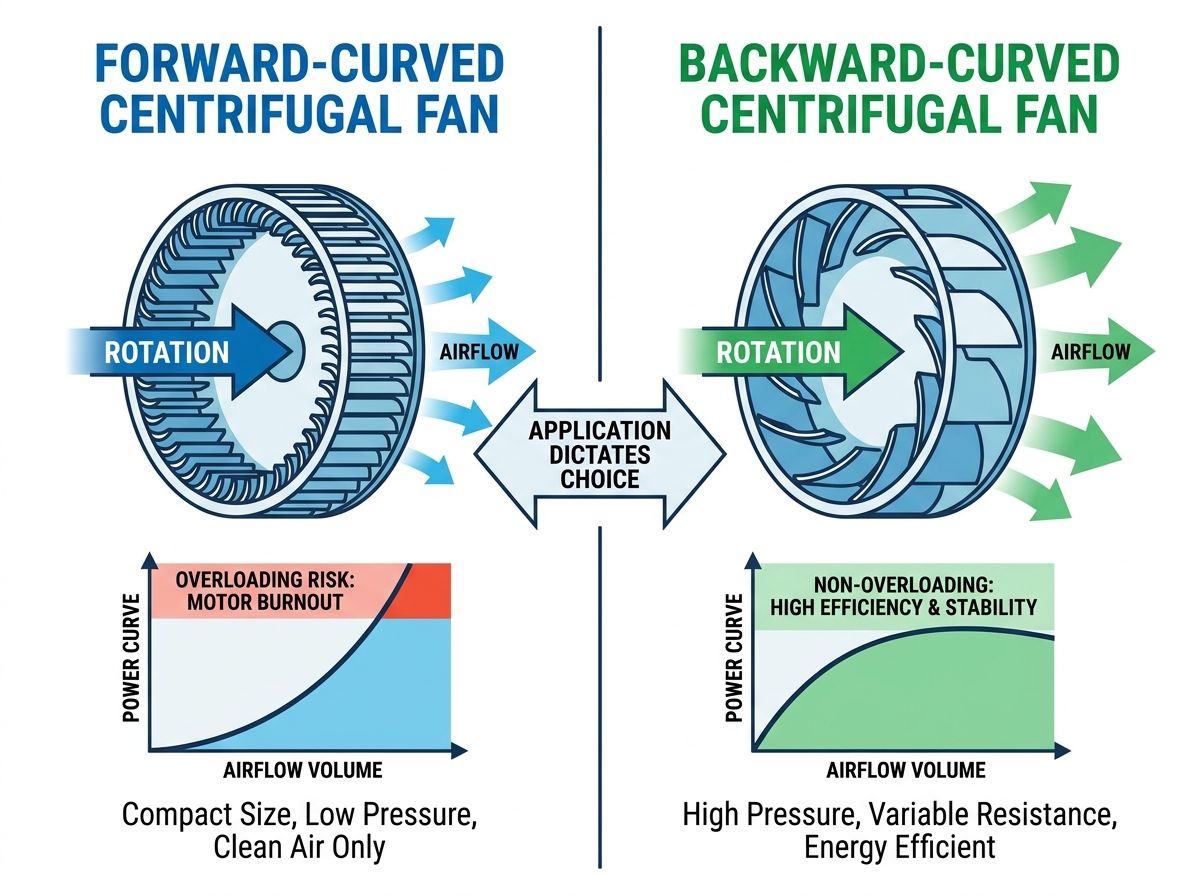
Forward-curved blades cup the air aggressively. They curve directly into the direction of wheel rotation. This specific geometry accelerates air rapidly across the blade surface. However, the impeller cannot build static pressure alone. It requires a specific scroll housing. The housing catches the fast-moving air. It expands the air stream gradually. This expansion converts raw kinetic energy into usable static pressure. You must always use a housing with this design.
Conversely, backward-curved blades tilt away from the rotation direction. They sweep the air outward smoothly. This design generates static pressure directly within the impeller itself. It relies much less on external containment. You can operate these fans inside a scroll housing if desired. Alternatively, you can run them without housing entirely. We call these unhoused units plenum fans. They pressurize the entire cabinet efficiently.
Rotational speed heavily influences mechanical wear and acoustics. A Forward-curved Centrifugal Fan operates at significantly lower RPMs. It achieves the required airflow volume much earlier than other designs. Lower speeds reduce the mechanical stress on bearings. This characteristic extends the physical lifespan of moving parts. It also shifts the acoustic profile downward. Low-speed operation generates lower-frequency sound waves. You can attenuate these low frequencies easily using standard insulation materials.
Backward-curved units must spin much faster. They match the same volume output but generate higher frequencies. These higher speeds demand precision balancing. They also require robust bearing assemblies to handle the centrifugal forces.
The chart below summarizes these critical mechanical dynamics.
| Performance Metric | Forward-Curved Fan | Backward-Curved Fan |
|---|---|---|
| Airflow Generation | High volume at lower speeds | High volume at higher speeds |
| Static Pressure Capacity | Low to moderate limits | High to very high limits |
| Power Curve Profile | Overloading profile | Non-overloading profile |
| Space Requirement | Highly compact footprint | Requires larger physical diameter |
Every engineering choice carries distinct benefits and inherent risks. You must evaluate this fan type against your specific operational boundaries.
Space is often a premium in commercial HVAC designs. This impeller offers a maximized airflow-to-size ratio. You get immense volume from a highly compact footprint. Engineers favor it for tight equipment enclosures. It delivers excellent performance where bulky units fail to fit. You can downsize the entire air handling unit.
Acoustics present another major advantage. Lower rotational speeds inherently produce lower-frequency acoustic signatures. Residential and commercial HVAC systems benefit greatly here. You can mask or absorb these sounds easily. Occupants rarely notice the background hum. It blends seamlessly into office environments.
You must understand the overloading power curve thoroughly. This represents a critical engineering risk. Imagine a scenario where system static pressure drops unexpectedly. Perhaps a maintenance worker removes a dirty filter. Maybe a large duct damper suddenly opens. The system resistance plummets instantly. Airflow increases exponentially as a result. The motor workload spikes immediately. It draws massive amounts of electrical current. Unless you installed proper electrical protection, the motor will burn out.
Furthermore, this design demands strictly clean air. The blade concavity acts like a rigid scoop. It traps dust and airborne debris continuously. Particulate buildup throws the impeller out of balance over time. Vibration increases sharply. Bearings fail prematurely. You must restrict these fans to highly filtered air applications.
We recommend these units for highly specific environments. They dominate inside VAV (Variable Air Volume) boxes. Domestic furnace blowers rely heavily on them. Fan coil units utilize their compact nature perfectly. You will also find them in compact electronic cooling arrays. In these scenarios, physical space serves as the primary bottleneck.
High-performance environments demand robust airflow solutions. This impeller type provides unmatched stability for demanding industrial and commercial applications.
Efficiency drives modern mechanical design globally. These impellers provide incredibly high aerodynamic efficiency. The swept blades move air incredibly smoothly. They convert mechanical energy to air movement efficiently. You experience minimal energy loss during continuous operation. This efficiency peaks when paired with modern EC motors. Electronically commutated motors maximize the aerodynamic benefits perfectly. They offer precise speed control.
The power curve provides unmatched operational stability. We call it a non-overloading power curve. Peak power consumption occurs near the middle of the performance range. What happens if system pressure drops to zero? The motor simply will not overload. The power draw actually decreases safely. You eliminate the risk of catastrophic burnout completely.
These units also handle aggressive environments effortlessly. They easily operate against extremely high static system resistance. Complex ductwork layouts pose absolutely no problem.
You must accommodate larger physical dimensions. This design requires a larger physical diameter. It needs this size to achieve the same air volume. Upgrading an old system often requires cabinet modifications. You cannot always execute a simple drop-in replacement.
Speed also introduces unique acoustic challenges. The required higher rotational speeds generate higher-frequency noise profiles. High-pitch sounds penetrate standard walls differently. You may need specialized acoustic dampening materials. Engineers must plan for sound attenuation early.
Industrial ventilation systems rely heavily on these rugged units. High-pressure HVAC roof units demand their static pressure capabilities. Data center CRAC units use them for reliable, continuous cooling. We strongly recommend them for environments facing variable system resistance. They handle changing filter loads perfectly.
Selecting the proper equipment requires structured analysis. Use these five critical lenses for your evaluation. They will clarify your engineering priorities quickly.
Resistance dictates your baseline fan choice. Evaluate your ductwork complexity carefully. Use the forward-curved option for low or moderate pressure environments. They perform well below 3 to 4 inches of water gauge. You must mandate backward-curved units for high-pressure systems. They push through heavy resistance effortlessly. They maintain flow when resistance spikes.
Assess your physical equipment envelope strictly. Measure the equipment housing carefully. Sometimes the available depth is heavily restricted. The forward-curved design provides the necessary density here. It moves more air per square inch of physical profile. You can shrink the entire system footprint safely.
Regulatory standards shape modern HVAC decisions globally. Backward-curved fans inherently align better here. They easily meet stringent modern energy-efficiency regulations. ErP directives heavily favor their aerodynamic profiles. You achieve higher system efficiency ratings immediately. They pair flawlessly with variable speed EC drives.
Consider the air stream conditions carefully. Forward-curved blades require heavily filtered upstream air. They simply cannot handle dust. The backward-curved profile is semi-self-cleaning. Air sweeps across the convex surface rapidly. It sheds light particulates naturally. They tolerate dirty environments much better. They require less frequent manual cleaning.
You must balance rotational speed against housing acoustics. The forward option operates quieter mechanically. However, it absolutely requires a restrictive scroll housing. The backward option spins much faster. It is potentially louder at the mechanical source. Yet, it adapts easily to unhoused plenum configurations. This flexibility often simplifies overall acoustic treatments significantly.
Do not rely on guesswork or assumptions. Follow this exact engineering framework. It ensures optimal performance and mechanical safety.
You need accurate baseline numbers first. Plot your required CFM carefully. CFM stands for Cubic Feet per Minute. Map this volume against your expected system static pressure. This single mathematical point determines your entire aerodynamic requirement. Use this point to review performance curves.
Determine if your system resistance will change. Do you use heavy MERV filters? Filters clog over time naturally. Will zone dampers open and close frequently? If your resistance varies, choose safety first. The backward-curved fan offers a highly stable power curve. It handles changing loads safely without risking the motor.
Get out your measuring tools immediately. Measure the maximum allowable diameter inside the cabinet. Measure the available depth for the fan module. Compare these strict dimensions against manufacturer data sheets. A highly efficient fan remains useless if it does not fit. Ensure you leave room for maintenance access.
Neither fan design is objectively "better" in a vacuum. Your specific application strictly dictates the winner. A Forward-curved Centrifugal Fan remains the superior choice for highly compact systems. It thrives flawlessly in low-pressure, clean-air environments. Conversely, a backward-curved fan stands as the absolute industry standard elsewhere. It dominates high-efficiency, high-pressure, and variable-resistance applications.
Stop guessing based on nominal size alone. Consult your specific system’s resistance curve today. Contact manufacturers directly. Request detailed flow and pressure data sheets. Compare your plotted operating point against their tested performance curves. This data-driven approach guarantees long-term operational success. It protects your equipment and optimizes performance.
A: Direct replacements rarely work. You face significant physical and electrical barriers. Backward-curved units require a larger physical footprint. They also demand different motor sizing. Their higher operational speeds alter torque requirements. Additionally, their housing needs differ completely. Always consult an engineer before attempting a swap.
A: These fans feature an overloading power curve. Mechanical resistance dictates their workload. Removing system resistance allows more air to flow. Moving more air requires much more mechanical work. The motor workload spikes instantly. This causes a massive amperage draw. Without electrical safeguards, the motor overheats and burns out quickly.
A: Both fan types utilize EC motors successfully. However, backward-curved impellers achieve the highest aggregate system efficiencies. Their inherent aerodynamic efficiency multiplies the electrical savings. EC motors provide precise speed control. This exact combination dominates modern, high-efficiency HVAC designs globally.


