


Views: 0 Author: Site Editor Publish Time: 2026-08-16 Origin: Site


Ventilation systems act as the lungs of modern infrastructure. Design choices at the equipment level carry incredibly high stakes. Choosing the wrong impeller type directly damages system efficiency. It shortens motor lifespans. It increases daily energy consumption. Blade orientation ultimately defines how a fan performs under stress. Forward-curved blades cup the air and pull it forward. Backward-curved blades lean away from the direction of rotation. This single mechanical distinction completely alters the aerodynamic profile.
We must evaluate these designs through both a technical and practical lens. This evaluation helps engineers and procurement teams make informed decisions. Does upgrading to a backward-curved design justify the larger footprint? Sometimes, a standard Forward-curved Centrifugal Fan provides everything a basic system needs. However, demanding industrial applications require robust solutions. You need clear data to navigate these mechanical trade-offs. You will learn about performance gaps, aerodynamic efficiency, and critical retrofitting risks.
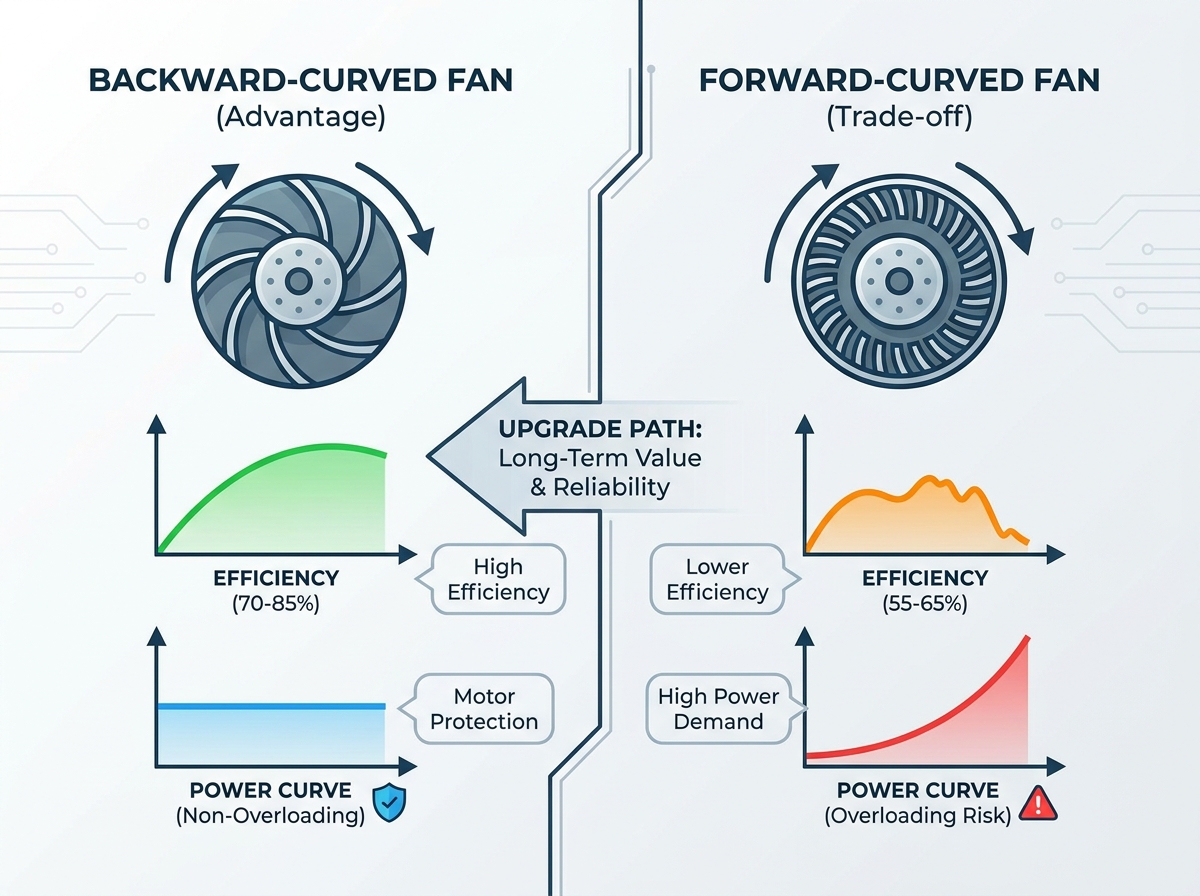
Fan motors fail when they draw too much electrical current. This usually happens when system resistance drops unexpectedly. Imagine an access door blowing open or a filter bank collapsing. A backward-curved impeller possesses a unique aerodynamic trait. Its power consumption rises to a specific peak and then actually drops as airflow increases. We call this a non-overloading power curve.
This curve acts as a built-in mechanical safety net. If static pressure vanishes, the fan moves maximum air but uses less power. The motor remains safe. We must contrast this behavior with a traditional Forward-curved Centrifugal Fan. Forward-curved blades aggressively bite the air. If resistance drops, they move exponentially more air and demand exponentially more power. Without strict damper controls or speed limiters, the motor will quickly overload and burn out. Engineers must actively manage this risk during system design.
Energy transfer mechanics define how well a fan converts electrical power into moving air. Backward-curved blades accelerate air smoothly. They guide the air stream without creating excessive turbulence at the blade tips. This smooth transfer minimizes energy waste. These fans routinely hit peak aerodynamic efficiencies between 70% and 85%.
Higher efficiency translates directly to lower daily energy usage. This matters heavily for compliance. Modern energy regulations demand strict efficiency minimums. The European ErP (Energy-related Products) directive and North American ASHRAE standards heavily penalize inefficient air movement. Relying entirely on older fan designs often makes it impossible to meet these modern building codes. Upgrading the impeller design ensures long-term compliance and reduces grid demand.
Modern ventilation setups often push air through complex obstacles. HEPA filtration banks, cooling coils, and long duct runs create immense static pressure. Fans must overcome this resistance to deliver required air volumes. Backward-curved impellers excel in these high-pressure environments. They generate strong, stable pressure differentials without stalling.
Their physical design allows them to spin much faster without catastrophic structural failure. This rotational speed builds the velocity pressure needed to punch through dense filters. When you design a heavily loaded industrial process, you need this pressure capability. A fan lacking this strength will simply churn air locally rather than pushing it down the duct.
Industrial air rarely stays perfectly clean. Dust, grease, and manufacturing particulates travel through the airstream. Blade shape directly impacts how a fan handles this debris. Backward-curved blades feature smooth, convex surfaces facing the airflow. Centrifugal force naturally throws dust off these blades. We consider them highly self-cleaning.
A standard Forward-curved Centrifugal Fan uses dozens of small, tightly packed blades. These resemble a squirrel cage. The cupped blade shape easily traps dirt, lint, and grease. As debris builds up, the fan wheel loses its balance. This imbalance causes severe vibration. Bearings fail prematurely. Maintenance teams must shut down the system frequently to manually scrub the fan blades. Self-cleaning designs drastically reduce this costly downtime.
Engineering always involves compromise. Forward-curved fans move highly impressive volumes of air at very low operating speeds. Because they cup the air aggressively, they do not need massive diameters to achieve high CFM (Cubic Feet per Minute). This allows manufacturers to house them in compact scroll enclosures.
Equipment footprint matters heavily in commercial construction. Mechanical rooms shrink every year to maximize leasable floor space. Packaged rooftop units (RTUs) must remain compact to avoid overloading roof structures. In tight spaces, the smaller footprint becomes a major asset. You simply cannot always fit a massive backward-curved assembly into an existing compact air handler.
Sound generation dictates fan selection in residential and light-commercial environments. Because forward-curved wheels spin much slower to generate airflow, they produce different noise profiles. They primarily generate lower-frequency sounds. In basic duct setups with low pressure drops, they operate quietly.
We often find them in fan coil units, residential furnaces, and small packaged air conditioners. High-speed fans generate aggressive, high-pitched aerodynamic noise. You must carefully consider the acoustic comfort of the space. Sometimes, slightly lower efficiency is an acceptable trade-off for quiet, unobtrusive operation in occupied areas.
Manufacturing complexity drives equipment pricing. Producing a squirrel cage wheel is highly automated and heavily standardized. Manufacturers punch and roll thin sheet metal to create the blades rapidly. This keeps production costs incredibly low.
For budget-restricted or low-duty projects, this upfront cost matters. If a fan only runs for a few hours a day, investing in complex aerodynamic blades might not make sense. Light-duty exhaust systems and intermittent ventilation units benefit from this lower initial purchase price. The simplicity of the assembly keeps replacement parts cheap and readily available.
You must map your system resistance curve against the fan's performance curve. This intersection dictates actual airflow. Backward-curved fans feature steep performance curves. If system resistance fluctuates slightly, the airflow remains relatively stable. This stability is perfect for systems with loading filters.
Conversely, a standard Forward-curved Centrifugal Fan features a flatter performance curve. A small change in static pressure causes a massive change in delivered airflow. If a filter gets slightly dirty, the airflow drops sharply. Engineers must match the curve shape to the predictability of the ductwork.
Modern HVAC relies on Variable Frequency Drives (VFDs) to modulate airflow. Slowing a fan down saves immense amounts of energy. However, not all fan wheels respond well to speed reduction. Backward-curved fans maintain excellent aerodynamic stability across incredibly wide RPM ranges. They do not stall easily when operating at 30% or 40% capacity.
When you slow down a forward-curved fan significantly, the airflow can detach from the blades. This causes aerodynamic stall and low-frequency surging. You must carefully program the VFD to avoid these stall zones. Stable performance under variable loads makes backward-curved options superior for modern, smart-building applications.
Maintenance teams evaluate equipment differently than design engineers. You must balance bearing wear against cleaning requirements. Backward-curved wheels spin much faster. This higher RPM puts more stress on shaft bearings. You must follow strict lubrication schedules to prevent bearing failure.
However, you save massive amounts of time on blade cleaning. Squirrel cage wheels spin slower, saving the bearings, but they demand rigorous manual cleaning. You must evaluate what your facility management team can realistically handle. Regular greasing is often easier than tearing down a housing to scrub trapped grease out of tiny blades.
Green building certifications look closely at mechanical efficiency. Achieving LEED (Leadership in Energy and Environmental Design) or BREEAM certifications requires stringent energy modeling. Fan power consumption represents a huge chunk of a building's energy footprint.
Selecting highly efficient backward-curved impellers actively contributes to these sustainability targets. They help secure points in energy optimization categories. While a basic forward-curved unit might meet baseline codes, it will rarely help a facility achieve premium environmental certifications.
The Technical Dimension Comparison Matrix below illustrates the core operational differences between these two impeller types.
| Technical Dimension | Forward-Curved Fan | Backward-Curved Fan |
|---|---|---|
| Peak Efficiency | 55% - 65% | 70% - 85% |
| Power Curve | Overloading (Needs safety margin) | Non-Overloading (Self-protecting) |
| Operating Speed | Low RPM | High RPM |
| Particulate Handling | Poor (Traps dust easily) | Excellent (Self-cleaning) |
| VFD Stability | Moderate (Risk of stall at low speeds) | High (Stable across wide ranges) |
Upgrading an existing system presents unique physical hurdles. You cannot simply remove an old fan and bolt a new one into the same space. Implementation requires careful mechanical planning. You must account for several critical shifts in system dynamics.
Dimensional Mismatches:
Replacing a forward-curved fan often requires significant physical modifications to the air handling unit (AHU). Because backward-curved fans need to be physically larger to push the same volume of air at a given pressure, the existing scroll housing usually will not fit. You might need to rebuild the plenum entirely. In some cases, engineers switch to unhoused plug fans to eliminate the scroll casing altogether, but this changes how air enters the ductwork.
Acoustic Shifts:
Changing the fan type completely alters the acoustic signature of the HVAC system. You will shift from a low-frequency hum to a higher-pitch aerodynamic noise due to the increased RPM. While high-frequency noise is actually easier to block with standard fiberglass insulation, it sounds more irritating to human ears if left untreated. You must warn building owners about this acoustic shift. Always budget for updated silencers, acoustic louvers, or thicker duct liners when executing a retrofit.
Engineers historically oversized fan motors to prevent catastrophic failures. With a traditional Forward-curved Centrifugal Fan, if the system resistance fell, the fan would over-speed and draw massive amps. Engineers countered this by installing motors 20% to 30% larger than necessary.
You must abandon this practice when installing backward-curved fans. Because they possess a non-overloading power curve, they physically cannot draw more power than their maximum designed peak. Engineers should size the motor much closer to the actual operating point. Over-specifying the motor wastes capital budget and forces the motor to run at a lower, less efficient load factor. Proper sizing improves the power factor and optimizes the electrical installation.
You must audit your current system before making a final procurement decision. Measure the exact static pressure of your existing ductwork under normal load. Determine your required duty cycle and map it against the fan performance curves. Once you gather this field data, you can confidently specify the right impeller for your specific ventilation needs.
A: Direct drop-in replacements are incredibly rare. Backward-curved fans typically require larger wheel diameters to achieve the same airflow. You will face dimensional mismatches. Furthermore, they run at higher RPMs, requiring different motor sizes and shaft mounts. You almost always need to modify the air handling unit cabinet or duct transitions to accommodate the new assembly properly.
A: It comes down to vector physics. The backward orientation of the blades leans away from the rotation direction. This reduces the absolute velocity of the air leaving the impeller tips. To compensate for this lower exit velocity and achieve equivalent volumetric flow (CFM), the fan wheel must operate at a significantly higher RPM.
A: Backward-curved fans perform far better in dusty environments. Their smooth, convex blade surfaces naturally deflect particles outward using centrifugal force. This self-cleaning action prevents dust accumulation. Conversely, forward-curved blades act like scoops, easily trapping grease and debris, which leads to severe wheel imbalance and frequent maintenance shutdowns.


