


Views: 0 Author: Site Editor Publish Time: 2026-08-01 Origin: Site


Selecting the right ventilation equipment requires balancing strict airflow demands against tight spatial constraints. Engineers must achieve high system performance without over-engineering the mechanical setup. Making the wrong choice often leads to excessive noise or costly mechanical failures. You need a reliable method to evaluate your options systematically.
A Forward-curved Centrifugal Fan serves as an industry standard for moving massive volumes of clean air at low static pressures. People often refer to it as a "squirrel cage" fan. It provides a highly reliable, space-saving solution for commercial air handling. Manufacturers rely on it heavily for OEM equipment.
While highly effective for specific HVAC and light industrial applications, misapplying this fan type causes problems. It can lead to severe motor overloading and premature failure. This guide outlines the technical realities, operational limits, and selection criteria essential for procurement and system design. You will learn how to match these units precisely to your operational needs safely.
How does the impeller actually function? It uses numerous shallow blades around the wheel perimeter. These blades curve gently in the direction of the wheel's rotation. As the wheel spins, they scoop the air. They accelerate the air tangentially to generate a high-velocity airflow stream. This fundamental aerodynamic approach defines the fan's unique performance characteristics.
Kinetic energy transfer plays a critical role here. The fan converts high-velocity pressure into usable static pressure. It relies heavily on the scroll housing, often called a volute, to achieve this. The housing captures the fast-moving air expelled by the blades. It then directs the flow while slowing it down slightly. This deceleration builds the necessary static pressure to push air through complex ductwork.
You will notice distinct structural differences in the "squirrel cage" impeller. It utilizes a very lightweight construction. The design features an unusually large number of blades. Most industrial and commercial units contain 24 to 64 individual blades. The visual similarity to a small rodent wheel earned it the squirrel cage nickname. Unlike other fan designs, it depends entirely on the scroll housing for directional efficiency. If you remove the housing, the air simply scatters radially. The fan loses all directional force and pressure capability.
Operating speed distinguishes these units from backward-inclined alternatives significantly. They generate required air velocities at much lower rotational speeds. Lower RPM translates directly into reduced mechanical wear on the bearings and shaft. It also means you experience much less operational vibration. This slower, smoother operation extends bearing life. It simplifies maintenance schedules for facility managers. Lower vibration limits acoustic resonance transferred into the building structure.
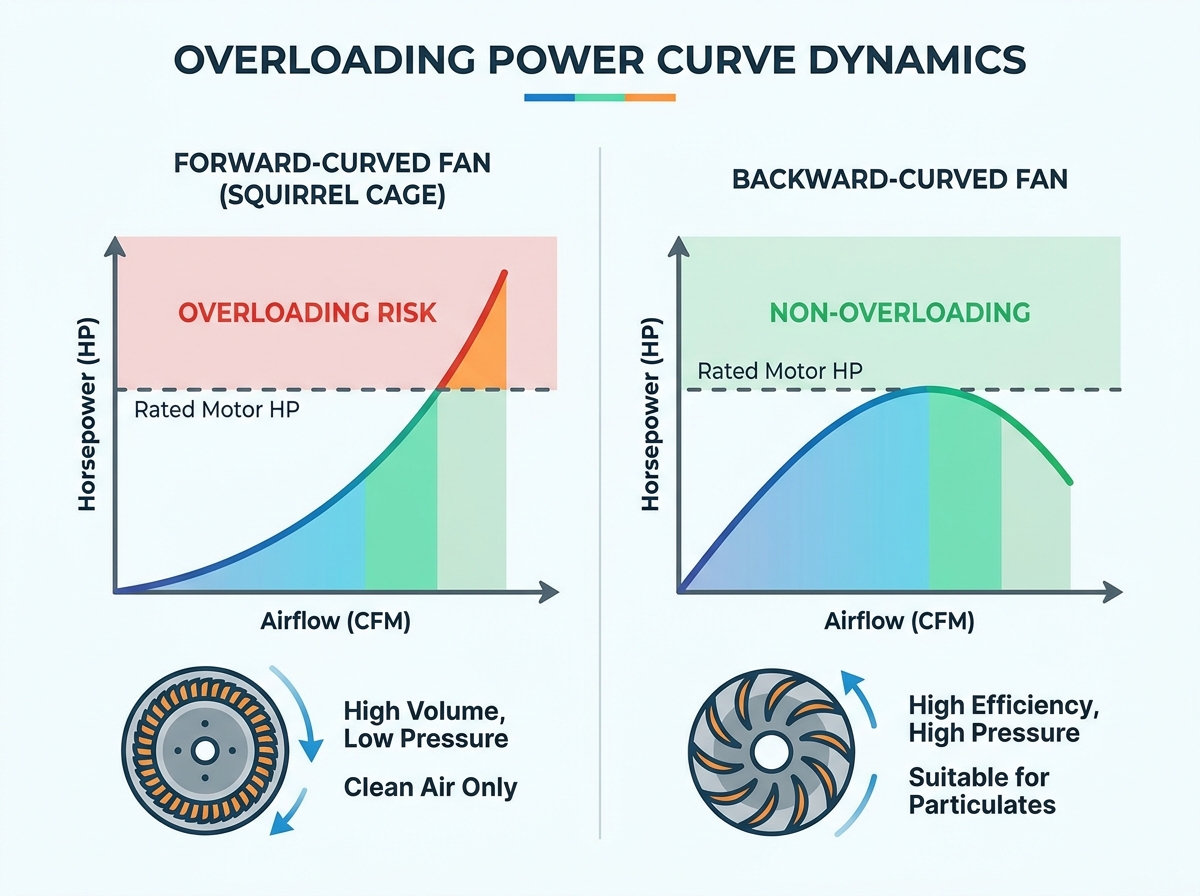
Engineers frequently face a common crossroad during system design. You must choose between forward and backward-curved models. Both serve distinct purposes in ventilation architecture. Making the right choice impacts long-term mechanical reliability. Understanding their core differences prevents catastrophic failures.
You must understand their peak efficiency limits. Forward-curved models generally peak around 60% to 65% static efficiency. They work beautifully for moderate commercial tasks where extreme efficiency is not the primary driver. Backward-curved models operate differently. They can easily exceed 80% to 85% static efficiency. This high efficiency makes them the preferred choice for continuous industrial processes. They handle high-energy demands flawlessly.
Power curve dynamics represent a crucial engineering reality. The Forward-curved Centrifugal Fan has an overloading power curve. What does this mean for you in practical terms? Motor horsepower increases as airflow increases. If system static pressure drops suddenly, airflow spikes rapidly. The motor will overdraw current immediately. You must size the motor precisely to prevent electrical failure. Backward-curved fans feature a non-overloading power curve. Motor horsepower peaks and then drops gracefully. This design inherently protects the motor from sudden pressure drops.
Noise levels dictate many HVAC integration decisions. Forward-curved units operate at lower speeds. This generally results in a lower frequency noise profile. Low-frequency sound is much easier to attenuate in commercial environments. You can manage it easily using standard duct lining and silencers. Backward-curved units spin much faster. They create higher-pitched noise profiles which penetrate building materials more easily.
| Performance Feature | Forward-Curved Fan | Backward-Curved Fan |
|---|---|---|
| Static Efficiency | 60% - 65% Peak | 80% - 85%+ Peak |
| Power Curve Type | Overloading | Non-overloading |
| Operating Speed (RPM) | Comparatively Low | Comparatively High |
| Acoustic Profile | Low-frequency baseline noise | High-frequency baseline noise |
| Space Requirement | Highly Compact | Requires larger housing footprint |
Finding the operational sweet spot guarantees long-term success. Engineers typically use these fans for specific pressure ranges. You should apply them where static pressure requirements remain relatively low. They perform best below 3 to 5 inches of water gauge (WG). Pushing them beyond this limit compromises their aerodynamic efficiency rapidly. They will consume excess power if forced to operate against high duct resistance.
Consider the dimensional advantages carefully during the design phase. A Forward-curved Centrifugal Fan delivers massive airflow inside tight spaces. It will move a specific CFM volume inside a remarkably small housing. A backward-curved fan requires a much larger footprint to produce an identical CFM. This compact nature drives adoption in space-restricted OEM equipment. You often see them buried deep inside packaged rooftop units and compact air handlers.
You need highly accurate calculations for system resistance predictability. Predictable system resistance remains strictly non-negotiable. Unpredictable duct systems pose a very high risk of motor burnout. If duct resistance falls unexpectedly below design parameters, the fan moves too much air. This immediately overloads the motor. The electrical current draw spikes past the safety limit.
Specifying motor capacity requires careful planning and realistic safety margins. We strongly advise over-sizing the motor slightly. A 10% to 15% safety buffer works exceptionally well in most commercial cases. This buffer accommodates potential operational drops in system static pressure. It protects your investment during unexpected filter changes or damper adjustments. You must prepare for real-world mechanical shifts.
Where do these mechanical units truly shine? They dominate several key commercial industries. You will find them installed in standard commercial HVAC air handlers. They power most fan coil units quietly and efficiently. Low-pressure ventilation systems rely on them daily. Exhaust systems in commercial office buildings utilize them extensively. They also excel in electronic cabinet cooling equipment. Clean-room filtration systems use them frequently. However, the intake air must be pre-filtered thoroughly before reaching the fan.
You must recognize their mechanical limitations to avoid engineering disasters. Misapplication leads to rapid equipment deterioration. Implementing them blindly into harsh industrial environments guarantees failure.
Never use them for dirty airstreams or material handling. The forward-facing cupped blades act like tiny mechanical scoops. They trap airborne dust, grease, and industrial particulates incredibly quickly. This rapid accumulation causes severe rotor imbalance. You will experience violent rotational vibration followed quickly by catastrophic bearing failure. The lightweight cage simply cannot handle heavy mass imbalances.
Extreme heat presents another major operational risk. Manufacturers build these impellers using lightweight construction techniques. The thin blades warp or degrade easily under extreme industrial exhaust temperatures. You can only use them in high-heat scenarios if the manufacturer utilizes specialized alloys. Standard galvanized steel cages will warp under intense thermal stress.
Avoid using them where static pressure fluctuates wildly. Environments where large bay doors open and close frequently prove highly problematic. Automated dampers cause drastic shifts in system resistance. These rapid fluctuations push the motor into its overloading zone continuously. The resulting thermal stress on the motor windings reduces its lifespan significantly.
How do you guarantee project success during procurement? Ensure your application perfectly matches the fan's inherent strengths. The project must require a compact mechanical footprint. It should demand low baseline noise levels. Most importantly, it must handle strictly clean air. The required static pressures must remain consistently in the low to medium range. If your project deviates from these parameters, consider backward-curved alternatives immediately.
Gathering accurate data speeds up the vendor evaluation cycle. You must define the target CFM exactly. Calculate the required Static Pressure in WG accurately. Note the precise air composition for the manufacturer. You must record baseline temperature and humidity levels. Always declare any potential presence of corrosives or fine particulates. Transparency with your vendor prevents critical sizing errors.
Choose your manufacturing partners wisely. Look for vendors who provide completely transparent fan performance curves. Demand verifiable AMCA (Air Movement and Control Association) certifications. This certification guarantees the manufacturer's performance claims match actual laboratory testing. Reliable manufacturers will offer robust technical support. They should actively help you verify your motor-sizing calculations. They should review your ductwork schematics if requested.
Take immediate action after shortlisting suppliers. Request a detailed fan curve chart from each vendor. Plot these charts directly against your specific system resistance curve. This visual comparison guarantees a safe operational match. It prevents costly post-installation modifications. Verify the peak horsepower requirement matches your selected electrical infrastructure.
A Forward-curved Centrifugal Fan remains an unparalleled engineering solution for modern air handling. It moves high volumes of clean air quietly and efficiently. It fits seamlessly into highly constrained spatial footprints where other fans simply cannot operate. However, long-term success depends entirely on accurately mapping your system resistance before purchase.
Always prioritize precise static pressure calculations over baseline equipment costs. Cutting corners on system mapping often causes severe maintenance issues. Proper planning prevents the catastrophic motor overloading commonly associated with this specific fan type. You must respect the overloading power curve to protect your mechanical investment.
Validate your system design today. Consult an experienced ventilation engineer before finalizing your purchase orders. Request specific, AMCA-certified performance curves from a reputable manufacturer to ensure a perfect operational match. Protecting your system upfront guarantees years of quiet, reliable airflow.
A: The name comes from the impeller's visual appearance. It features a cylindrical shape with many closely spaced, parallel blades around its perimeter. This lightweight, multi-blade design looks remarkably similar to a standard exercise wheel used by pet rodents.
A: No. Unlike simple propeller fans, it requires a scroll housing to function properly. The housing captures the high-velocity air leaving the impeller blades. It slows the air down slightly, converting kinetic energy into usable static pressure to direct the airflow through ductwork.
A: You must accurately calculate system static pressure beforehand. Utilize proper damper controls to prevent sudden pressure drops. Most importantly, review the fan's performance curve and select a motor horsepower that covers the highest potential peak on the overloading curve.
A: Generally, no. Kitchen exhaust contains heavy grease and particulates. The forward-cupped blades act like small scoops, trapping grease rapidly. This accumulation destroys the wheel's delicate balance, causing severe vibration and eventually destroying the fan bearings. They require extreme pre-filtration to survive.


