


Views: 0 Author: Site Editor Publish Time: 2026-08-23 Origin: Site


The debate between forward and reverse fan designs spans many industries. From cooling high-end PC cases to ventilating massive industrial complexes, picking the right airflow geometry is crucial. Engineers must understand how air interacts with different blade shapes.
In commercial, HVAC, and industrial settings, this decision specifically concerns blade curvature. Picking the wrong impeller geometry routinely causes motor overloading. It also creates excessive noise and wastes substantial energy. System designers and facility managers must make accurate choices early in the planning stage.
This guide strips away marketing fluff to objectively compare these distinct aerodynamic profiles. We evaluate system resistance, operating efficiency, and long-term reliability. You will learn exactly how to match the right centrifugal blower to your precise application needs.
Selecting a commercial fan is not about finding an objectively superior product. It involves matching specific aerodynamic characteristics to unique environmental demands. You must carefully balance system resistance against your available spatial footprint. Every ventilation system generates static pressure. The fan you choose must overcome this resistance efficiently. By understanding the mechanical geometry of different blades, you can easily avoid costly installation failures.
Mechanically, designers build these fans so their blades curve in the direction of the fan wheel's rotation. The industry commonly refers to this design as a "squirrel cage" blower. They feature a large number of shallow, forward-facing blades situated around the impeller edge.
Engineers design them specifically to move large volumes of air at relatively low operating speeds. These units excel in low static pressure environments. They rely on the rapid tangential velocity of the air leaving the blade tips. This unique geometry converts kinetic energy into static pressure within the fan housing. A Forward-curved Centrifugal Fan requires a specialized scroll housing to direct this airflow properly.
In stark contrast, these fans feature blades curving away from the direction of rotation. They look as though they are sweeping backward as the wheel turns. They typically possess fewer blades than their forward-curved counterparts. The blades are also noticeably longer and much sturdier.
Manufacturers engineer these reverse fans for significantly higher aerodynamic efficiency. They operate safely at much higher rotational speeds. This makes them highly capable of overcoming steep system resistance. They push air effectively through thick HEPA filters, complex dampers, and extensive ductwork networks. They forcefully accelerate air outwards, requiring less reliance on a tight scroll housing for pressure conversion.
Understanding where a specific fan geometry thrives helps you avoid disastrous mechanical failures. Forward-curved impellers dominate specific sectors for very good reasons. They offer distinct advantages regarding capital expenditure and spatial integration.
These units shine in packaged HVAC units and residential furnaces. You will also find them frequently used in localized extraction systems. In these scenarios, physical space remains at an absolute premium. Additionally, the operating pressures within these systems remain consistently low and highly predictable.
Despite their popularity, you must carefully manage their inherent operational limitations. The most critical danger involves their specific power curve geometry.
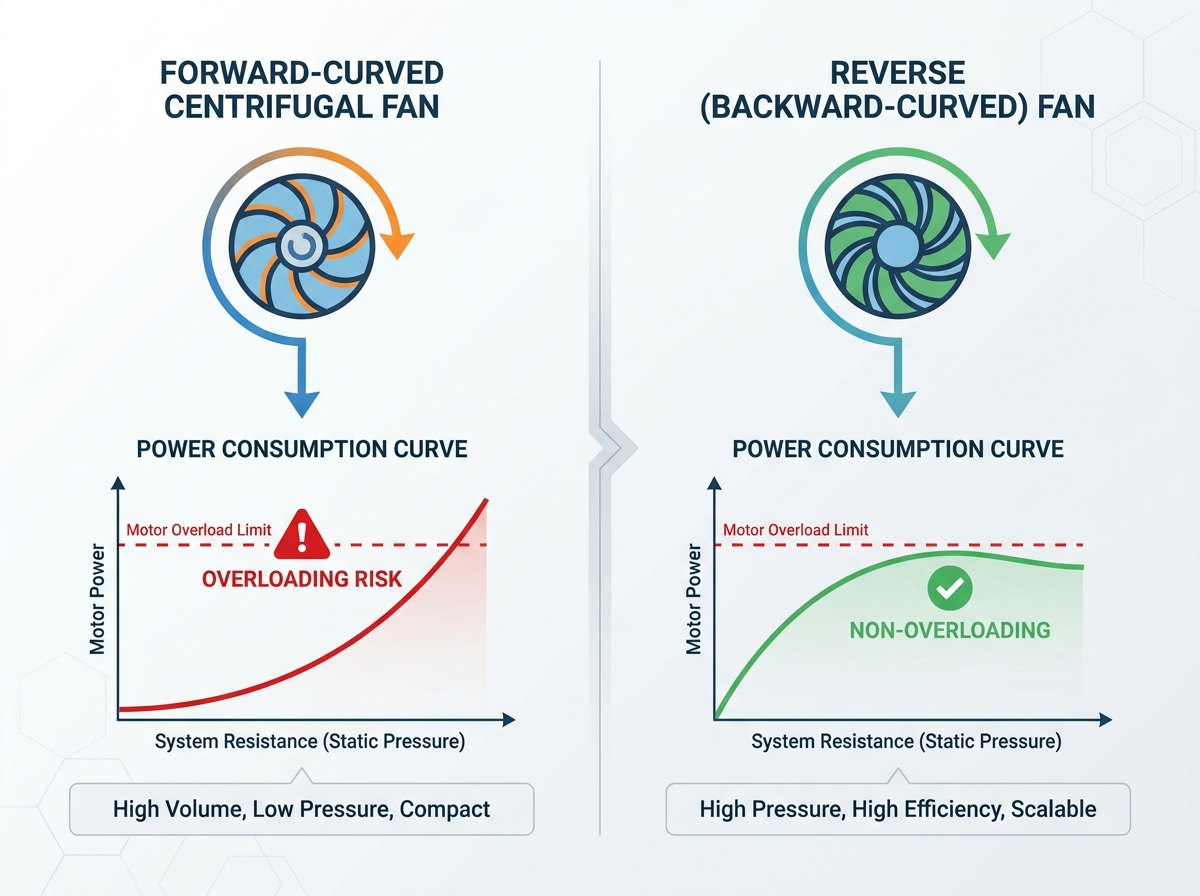
When system demands escalate, engineers turn to backward-curved technology. These robust units handle challenging aerodynamic environments easily. They prioritize long-term reliability and operational stability over compact form factors.
You will see them dominate heavy industrial ventilation systems and demanding cleanroom environments. They represent the industry standard for Variable Air Volume (VAV) systems. They thrive in any environment experiencing constantly fluctuating system resistance.
You must accommodate their physical and acoustic requirements during the early design phases.
Selecting the correct unit requires a structured approach. You must weigh physical constraints against long-term operational goals. We break down the primary evaluation dimensions below to clarify the decision-making process.
The fundamental trade-off always involves physical space versus aerodynamic efficiency. If your enclosure space is strictly limited, a Forward-curved Centrifugal Fan remains your best option. They maximize volume-to-space ratios brilliantly.
Conversely, if operational expenditure reduction dictates your project priorities, select reverse/backward-curved models. You must also evaluate system static pressure resilience. Carefully assess your system's filter lifecycle. If filters will load heavily and increase resistance significantly over time, backward-curved fans maintain performance far more reliably. They push through the added resistance without stalling or surging.
Modern sustainability mandates profoundly influence equipment selection. You must address strict energy compliance codes during your design phase. Standards like ASHRAE 90.1 in North America and the European ErP Directive set rigorous efficiency minimums.
Reverse-curved fans easily meet these demanding thresholds. Manufacturers increasingly pair them with EC (Electronically Commutated) motors. This combination delivers exceptional part-load efficiency. It has become practically mandatory for new commercial construction projects aiming for LEED certification or strict regulatory compliance.
Aerodynamic Comparison Matrix
| Evaluation Metric | Forward-Curved Blade | Reverse (Backward-Curved) Blade |
|---|---|---|
| Impeller Geometry | Curves toward rotation direction | Curves away from rotation direction |
| Peak Efficiency | 55% - 65% | 70% - 85% |
| Motor Overload Risk | High (if system pressure drops) | None (non-overloading power curve) |
| Physical Footprint | Highly compact | Requires larger diameter |
| Primary Application | Residential HVAC, Light commercial | Industrial VAV, Cleanrooms |
Even the best fan fails if installed incorrectly. You must anticipate common integration hurdles. We outline the most prevalent risks engineers encounter in the field.
You must actively mitigate the risk of the "system effect." This phenomenon occurs when poor inlet or outlet duct conditions ruin aerodynamic performance. A Forward-curved Centrifugal Fan is notoriously sensitive to uneven airflow at its inlet.
Common Mistake: Installing a sharp 90-degree duct elbow immediately before the fan inlet. This creates severe turbulence. It completely destroys the fan's rated efficiency and generates intense vibration. You should always ensure straight duct runs for at least three duct diameters before the inlet.
Do not underestimate routine maintenance requirements. Forward-curved blades feature much smaller, tighter gaps between individual fins. They easily trap grease, dust, and particulate matter. They require frequent, rigorous cleaning schedules.
If you neglect this maintenance, debris builds up rapidly. The impeller becomes severely unbalanced. This imbalance destroys bearings prematurely and causes massive mechanical failure. Reverse-curved blades shed dust much more effectively due to their open geometry and higher rotational speeds.
To finalize your procurement strategy, follow these straightforward steps:
There is no universal "better" fan geometry. The correct choice entirely depends on matching aerodynamic capabilities to your specific resistance and spatial parameters. Understanding their distinct power curves protects your electrical infrastructure.
Choose a Forward-curved Centrifugal Fan for clean, low-pressure, space-constrained environments. They keep initial capital costs low while operating quietly. Alternatively, opt for a reverse (backward-curved) fan for heavy-duty, high-pressure, continuous operations. Their inherent energy efficiency and motor safety features make them indispensable for complex industrial applications.
Take action today by consulting directly with a qualified application engineer. Ask them to plot your specific system resistance curve directly against the manufacturer's fan performance curves. This simple step guarantees maximum long-term efficiency and system reliability.
A: No. Reversing the electrical polarity or motor rotation on a centrifugal fan does not reverse the airflow direction. It simply drastically reduces the fan's efficiency and airflow output. Running it backward causes severe turbulence and can permanently damage the motor. Air is always discharged out of the housing outlet, regardless of rotation.
A: Its specific aerodynamic design ensures that maximum power absorption occurs near its peak efficiency point. If system resistance drops entirely to zero, the power required actually decreases. This unique power curve physically protects the motor from drawing excessive electrical current and burning out.
A: No. In PC cooling, a "reverse fan" simply flips the blade angle so the strut and frame remain hidden for aesthetic purposes. They maintain a specific intake or exhaust direction. Industrial forward or reverse terminology refers specifically to the blade's curvature relative to the wheel's rotation to manipulate static pressure.


