


Views: 0 Author: Site Editor Publish Time: 2026-06-03 Origin: Site


Understanding the working principle of air movement equipment is not just an academic exercise. It serves as the absolute foundation for calculating system impedance and preventing catastrophic performance failures in industrial environments. Misunderstanding how these machines convert kinetic energy into static pressure routinely causes expensive engineering errors. You might end up with undersized equipment, excessive energy consumption, and massive hidden efficiency losses. You need to grasp these physical mechanics to ensure reliable daily operation in heavy-duty HVAC and material handling setups.
This article bridges the complex physics of air movement with practical, bottom-of-funnel procurement logic. We will help engineers and technical buyers evaluate, shortlist, and specify the exact right equipment for their facilities. You will learn about crucial pressure ratios, diverse blade geometries, and real-world installation risks. By mastering these concepts, you can select optimal equipment tailored to your specific industrial demands.
Centrifugal fans utilize rotational centrifugal force to turn incoming axial air 90 degrees, generating high static pressure capable of overcoming heavy system resistance.
Impeller geometry (forward-curved, backward-curved, radial) directly dictates not only efficiency and footprint but also the electrical control logic required.
Environmental variables (altitude, temperature) drastically alter air density, requiring strict Standard Cubic Feet per Minute (SCFM) correction factors during the procurement phase.
Installation risks are unique; unlike axial fans, improperly wired three-phase centrifugal fans will still move air in the correct direction but at a severely reduced capacity, creating hidden operational drains.
A centrifugal fan operates through a highly efficient mechanical process. It relies on rotational energy to create a stable, pressurized airstream.
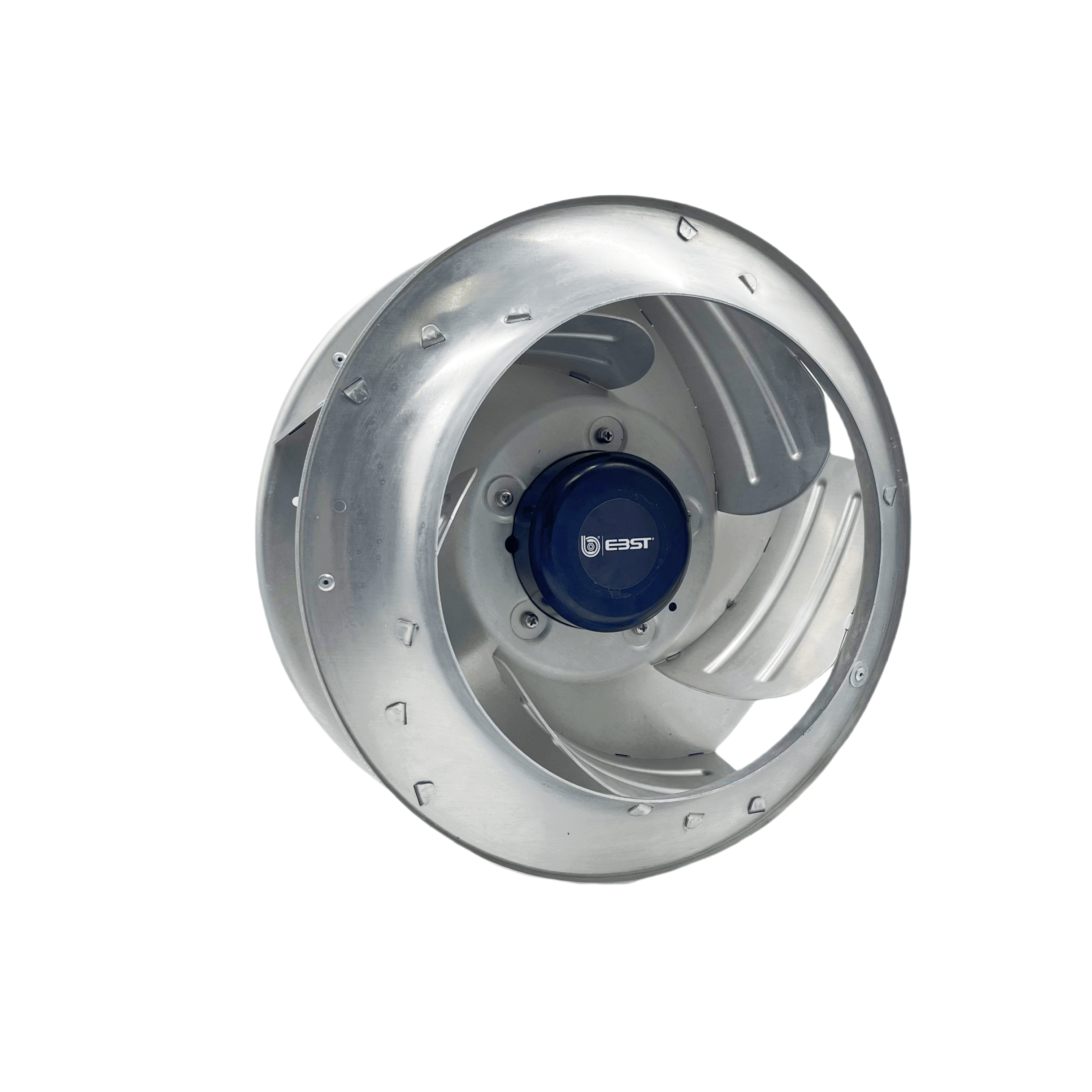
Air enters the equipment axially through the center, commonly known as the eye of the impeller. The spinning impeller blades grab this air. Centrifugal force rapidly accelerates the air outward in a radial direction. The air then exits the impeller at a 90-degree angle to its original entry path.
The volute casing plays a critical role in this process. This spiral-shaped housing acts as a kinetic diffuser. It catches the high-velocity air flying off the impeller tips. The casing gradually expands in volume, which forces the air to slow down. This deliberate velocity reduction converts raw kinetic energy into stable, high static pressure. You need this static pressure to push air through restrictive ductwork.
Industry standards strictly define equipment based on specific pressure ratios. The American Society of Mechanical Engineers (ASME) provides clear parameters to guide your procurement terminology.
Fans: Operate at a specific pressure ratio of up to 1.11.
Blowers: Operate at a specific pressure ratio between 1.11 and 1.20.
Compressors: Operate at a specific pressure ratio exceeding 1.20.
Understanding these thresholds prevents costly specification errors. You should never order a fan when your system resistance actually requires a blower.
Axial fans rely on aerodynamic lift. They function much like an airplane wing. The blades slice through the air, creating a pressure difference. This pulls high volumes of air straight through the housing. However, axial fans generate very low pressure. They struggle against system resistance.
Centrifugal units rely on kinetic displacement. They hurl air outward to build substantial force. This kinetic displacement makes them ideal for demanding applications. They easily push air through high-resistance HEPA filters, complex ducting networks, or wet scrubbers.
The shape of the impeller blades completely changes how the equipment behaves. Geometry dictates efficiency, physical footprint, and the electrical control logic required.
Engineers often call this the "hamster wheel" design. Forward-curved impellers feature many small blades curving toward the direction of rotation. They offer a very compact footprint. They operate effectively at lower rotational speeds, making them exceptionally quiet.
You will typically find them in standard commercial HVAC units. They work best in low-pressure, high-volume clean air environments. Control logic requires careful monitoring. Power consumption correlates directly with airflow volume. If airflow increases unexpectedly, the motor can draw excess current. You can monitor and control specific operational points directly via motor current readings.
These impellers feature blades curving away from the direction of rotation. They provide the highest energy efficiency among standard designs. They feature a non-overloading power curve. If system resistance drops, the motor will not burn itself out. You can even operate them without a traditional volute housing. Industry professionals call this a "plug fan" or a free-running setup.
Businesses use them heavily in industrial ventilation and continuous-duty exhaust systems. However, control logic differs significantly. You cannot control backward-curved units accurately via motor current. You must rely on nozzle pressure differential measurements to monitor performance.
Radial impellers use heavy-duty straight blades radiating outward from the central hub. They offer the lowest aerodynamic efficiency. However, they are incredibly rugged and completely self-cleaning.
Industrial applications mandate radial blades for heavily contaminated air streams. If you operate pneumatic conveying systems or handle fibrous materials, you need this geometry. Other blade types would instantly clog, unbalance, and fail under these harsh conditions.
Geometry Type | Primary Advantage | Best Application | Control Nuance |
|---|---|---|---|
Forward-Curved | Compact footprint, low noise | Standard clean-air HVAC | Control via motor current |
Backward-Curved | High efficiency, non-overloading | Heavy industrial ventilation | Control via pressure differential |
Radial (Straight) | Rugged, self-cleaning | Material handling, heavy dust | High power required |
Even perfectly specified equipment experiences efficiency losses. You must understand physical variables and installation risks to maintain operational integrity.
Many engineers size equipment based entirely on standard air conditions (SCFM). They fail to correct for actual operational reality. This oversight creates severe performance bottlenecks.
Temperature and altitude drastically change air density. Air at 200°F weighs significantly less than air at 70°F. The impeller pushes less mass per revolution. To hit your required pressure at high temperatures, you must apply a pressure correction multiplier. For 200°F air, you might need a 1.25x multiplier. Failing to calculate this exact variable leads to catastrophic equipment under-specification.
Friction destroys efficiency. You must identify and mitigate the primary friction zones inside the housing.
Impeller Entry Turbulence: Poor inlet duct design causes turbulent air entry, dropping initial efficiency.
Volute Expansion Losses: Improper casing angles create eddy currents instead of smooth deceleration.
Disc Friction: The exterior of the spinning impeller dragging against surrounding air wastes motor power.
You must strictly monitor the 0.25% clearance rule. The gap between the impeller tip and the inlet cone should ideally sit at 0.25% of the impeller diameter. Exceeding this tolerance causes internal air leakage. High-pressure air bleeds back to the low-pressure inlet, destroying your system pressure drops.
Onsite commissioning often reveals a frustrating troubleshooting reality. Technicians sometimes miswire three-phase electrical connections. The motor then spins backward.
If an axial fan is miswired, it blows air backward. The error is instantly obvious. If a centrifugal unit is miswired, the impeller spins backward. However, centrifugal force still flings air outward. The volute casing still directs air toward the discharge. It continues to blow air in the designated direction, but at a fraction of the specified power.
Non-specialists rarely diagnose this root cause. They assume the equipment is simply weak. Furthermore, running backward risks static pressure exceeding dynamic pressure. This imbalance causes system stall and dangerous backward airflow under high-resistance conditions.
Optimizing equipment requires careful selection of drive mechanisms. You must balance mechanical efficiency against noise pollution regulations and energy recovery tactics.
Drive mechanisms determine how motor power transfers to the impeller. Each approach offers distinct engineering trade-offs.
Direct drive configurations mount the impeller directly onto the motor shaft. They offer higher upfront efficiency and zero transmission loss. They require far lower mechanical maintenance. You can achieve exact speed matching using Variable Frequency Drives (VFDs).
Belt drive systems utilize pulleys and mechanical belts. They introduce inherent slippage. This slippage creates measurable efficiency loss and requires regular belt maintenance. However, they offer crucial mechanical flexibility. You can adjust the final RPM independently of motor frequency. This proves vital when mitigating international grid discrepancies, such as adapting 60Hz equipment for a 50Hz facility.
Industrial drying operations consume massive amounts of thermal energy. You can optimize operational expenses by implementing hot air recirculation loops.
Instead of venting hot exhaust to the atmosphere, you route high-velocity exhaust back to the system inlet. The impeller pulls this pre-heated air into the process again. This technique drastically reduces the secondary heating loads required to maintain drying temperatures. It transforms waste heat into a valuable operational asset.
High-velocity air movement generates significant noise pollution. Facilities must adhere to strict occupational safety regulations regarding decibel levels.
Engineers now specify biomimetically optimized blades to solve this issue. Taking inspiration from nature, manufacturers add serrated trailing edges to the impellers. They also utilize corrugated leading edges. These physical modifications break up turbulent vortices as air leaves the blade tip. This destroys the tonal noise frequencies before they amplify inside the ductwork.
Purchasing the correct equipment requires rigorous data collection. You cannot rely on generic airflow metrics to make a sound technical decision.
Before contacting any vendor, you must establish exact operational parameters. Gather these five data points to secure an accurate quotation:
Total Static Pressure Requirements: Measured in Pascals (Pa) or inches of water gauge (inWG).
Volumetric Flow Rate: Clearly distinguish between Actual (ACFM) and Standard (SCFM) requirements.
Media Environment: Note if the air is clean, caustic, fibrous, or requires an explosive/ATEX rating.
Temperature Extremes: Document both ambient environment temperatures and internal operating temperatures.
Site Altitude: Note the exact elevation above sea level to calculate air density drops.
Next, determine the physical configuration that best suits your infrastructure. You must choose between a single-stage unit for fixed volume or a multi-stage unit for variable, complex airflow needs.
Consider inline centrifugal designs if space is tight. They combine strong centrifugal pressure capabilities with axial-style straight duct mounting. Pay close attention to discharge orientation. Select an upblast configuration for hazardous fume extraction. This throws dangerous chemicals high into the atmosphere. Select a downblast configuration for general ambient cooling and roof-mounted supply systems.
Never accept peak theoretical ratings from a sales brochure. Peak efficiency only happens at one specific point on a performance curve.
Demand transparency from your suppliers. Request comprehensive performance curves mapped directly against your specific system impedance. You need to see exactly where the equipment operates under your unique field conditions. The right vendor will readily provide certified, test-backed data for your designated operating point.
Selecting reliable air movement equipment requires looking past generic airflow marketing metrics.
You must understand how pressure ratios, blade geometries, and air density interact to determine true performance.
Always finalize your site's actual impedance data and environmental variables before soliciting vendor quotes.
Account for the hidden drops in air density caused by high temperatures or elevations to avoid chronic under-specification.
Consult directly with application engineers to review specific pressure drop calculations and custom housing clearances before installation.
A: The distinction relies entirely on specific pressure ratios. Fans operate at a ratio up to 1.11, generating moderate pressure. Blowers operate between 1.11 and 1.20, generating significantly higher pressure. You specify blowers when severe system resistance exists, such as in dense filtration or heavy pneumatic conveying setups.
A: They utilize radial blade designs and a unique 90-degree expulsion path. This geometry forcefully ejects heavy particulate matter outward. It prevents fibrous materials from wrapping around the motor shaft or stalling the aerodynamics, making them immune to the clogging issues that plague axial designs.
A: Frequency directly drives motor speed. You calculate RPM using this formula: (120 x Frequency) / Motor Poles. A motor designed for 60Hz loses roughly 20% of its rotational speed when operated on a 50Hz electrical grid. Unless you use a Variable Frequency Drive, performance will drop severely.
A: Yes. These units possess excellent dual-functionality. By simply reversing the ductwork connection logic—routing the hazardous area to the unit's inlet—high-velocity blowers transform into incredibly powerful extraction units. Facilities use this setup constantly for localized fume extraction and industrial vacuum applications.


